







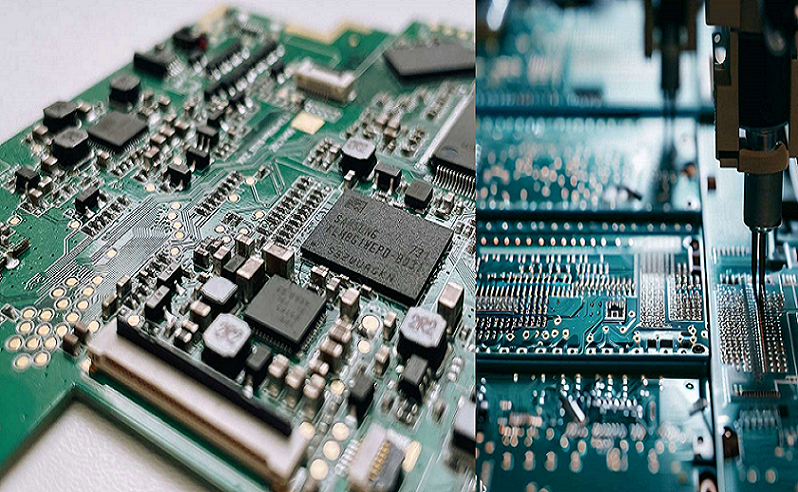
Assembly and Rework Challenges of HDI PCBs
Electronics engineers and production managers face consistent obstacles in high density interconnect PCB assembly and rework. Miniaturized features, micron-level tolerances, and complex layer structures create higher risks of component damage, solder defects, substrate warpage, and irreversible failure during manufacturing and repair. Even minor deviations in placement, thermal control, or rework technique can lead to significant yield loss, increased costs, and reliability risks in high density interconnect PCB production. This guide provides factory-verified engineering insights, quantifiable parameters, and structured solutions for every stage of HDI PCB assembly and rework.
Learn more about: How Does High Density Interconnect (HDI) Affect BGA Fanout and Component Placement?
Key Assembly & Rework Challenges
Fine-Pitch Component Handling
Fine-pitch devices represent the most frequent source of HDI PCB assembly defects, with tight geometries requiring extreme precision.
- Placement tolerance limited to ±1 μm for 0.2 mm pitch BGAs and QFNs
- Pad sizes as small as 0.25 mm × 0.25 mm, increasing bridging and insufficient wetting risks
- 01005 and smaller passive components prone to mechanical damage and tombstoning
- High risk of positional shift caused by substrate warpage during reflow
Microvia & Via-in-Pad Issues
Microvias and via-in-pad structures define HDI circuit boards but introduce unique assembly and rework vulnerabilities.
- Microvia diameters from 25 μm to 150 μm, with aspect ratios restricted to 1:1 per IPC-6016
- Solder wicking into unfilled microvias reduces joint strength and creates open circuits
- Stacked and staggered microvias limit access during rework, often making repairs impossible
- Void formation in filled microvias weakens structural integrity and thermal performance
Thin & Complex Substrates
Thin dielectric layers and advanced stackups create mechanical and thermal instability in HDI PCBs.
- Core thickness as low as 0.4 mm and build-up dielectric layers down to 12 μm
- Warpage exceeding 0.75% violates IPC-6016 and causes SMT placement failure
- Sequential lamination structures sensitive to thermal shock and mechanical stress
- Increased risk of delamination during rework and multiple reflow cycles
Solder & Thermal Process Challenges
HDI PCB materials and layouts impose strict limits on soldering and thermal exposure.
- High-Tg and low-loss laminates require controlled ramp rates ≤ 2 °C/second
- Peak reflow temperatures restricted to 230 °C – 240 °C to protect thin dielectrics
- Dense layouts create thermal gradients and hotspots that disrupt adjacent components
- Standard Type 3 solder paste too coarse for 0.2 mm–0.3 mm pitch applications
Rework Limitations
Rework operations on HDI printed circuit boards carry significantly higher failure risks.
- High likelihood of pad liftoff or trace tearing during component removal
- Limited physical access to densely placed components
- Inner-layer microvias cannot be repaired after lamination
- Impedance drift often occurs after rework due to trace damage or geometry change
Inspection & Testing Barriers
Micro-scale features require advanced inspection systems not used in conventional PCB production.
- AOI resolution of 1 μm required to detect micro-bridging between fine traces
- 3D X-ray necessary for identifying hidden solder voids and microvia defects
- Flying probe testing requires ±2 μm accuracy to avoid damaging fine traces
- Impedance verification needed after assembly to ensure high-speed signal stability
How to Resolve Fine-Pitch Component Handling Issues
Precision Assembly Equipment & Calibration
Stable, high-precision equipment forms the foundation of reliable HDI PCB assembly.
- Pick-and-place systems with ±1 μm accuracy and 3D vision alignment
- Customized vacuum nozzles for 01005 components and 0.2 mm pitch BGAs
- Daily calibration to compensate for machine drift and substrate warpage
- Integrated SPI for real-time solder paste deposition verification
Solder Paste & Deposition Optimization
Solder paste and stencil engineering directly determine fine-pitch soldering quality.
- Type 4, 5, or 6 solder paste with particle sizes from 20 μm to 38 μm
- Laser-cut stencils at 50 μm – 75 μm thickness with tapered apertures
- Aperture-to-pad ratio optimized at 1:1 per IPC-7351
- 100% SPI inspection with ±10% volume tolerance control
HDI Substrate Fixturing & Warpage Mitigation
Stabilizing thin HDI substrates eliminates placement and soldering defects.
- Vacuum fixturing to flatten substrates ≤ 0.8 mm thickness
- Symmetric top-bottom heating during reflow
- Ramp rates controlled at 1.0 °C – 1.5 °C per second
- Warpage reduced to ≤ 0.4% for stable assembly
Fine-Pitch Soldering Process Controls
Tuned soldering processes reduce defects in high-density HDI board assembly.
- Nitrogen reflow at O₂ levels < 500 ppm for improved wetting
- Preheat temperatures maintained at 150 °C – 180 °C for 60–90 seconds
- Selective soldering nozzles ≤ 0.5 mm for QFN devices
- Solder voids controlled to < 5% per IPC-A-610 Class 3
Rework-Specific Techniques & Tools
Specialized rework methods prevent permanent damage to HDI circuit boards.
- Laser-guided rework stations with ±2 °C thermal accuracy
- 3D vision alignment for BGA replacement and reballing
- Micro nozzles for localized, low-stress hot-air delivery
- Kapton masking to protect adjacent fine traces during repair
Post-Process Inspection & Validation
Comprehensive inspection ensures reliability in finished HDI PCBs.
- 1 μm resolution AOI for micro-bridging and alignment checks
- 3D X-ray inspection for BGA voids and microvia integrity
- Flying probe testing with ±2 μm probe accuracy
- Impedance verification for high-speed signal paths
Material & DFM Optimization
Design-for-manufacturability changes reduce assembly challenges at the source.
- Solder mask dams of at least 15 μm between fine-pitch pads
- Slightly enlarged pads by 5 μm – 10 μm for 0.2 mm pitch components
- No-flow underfill for BGAs to improve mechanical stability
- Clearance rules for rework access around dense components
HDI vs. Conventional PCB Assembly Comparison
| Parameter | HDI PCB Assembly & Rework | Conventional PCB Assembly & Rework |
|---|---|---|
| Minimum Component Pitch | 0.2 mm – 0.4 mm | ≥ 0.8 mm |
| Placement Accuracy | ±1 μm | ±5 μm |
| Solder Paste Type | Type 4 / 5 / 6 | Type 3 |
| Substrate Thickness | 0.4 mm – 0.8 mm | ≥ 1.6 mm |
| Warpage Requirement | ≤ 0.75% | ≤ 1.5% |
| Inspection Standard | 1 μm AOI + 3D X-Ray | Standard AOI + Visual |
Quality Control for HDI PCB Assembly
In-Process Quality Standards
- IPC-6016 microvia plating thickness ≥ 15 μm
- IPC-A-610 Class 3 solder joint requirements
- 100% X-ray inspection for microvia filling and BGA voids
- Thermal cycling from -40 °C to 125 °C for 500 cycles
Final Quality Validation
- Full electrical testing by flying probe or ICT
- Impedance tolerance within ±5% for controlled impedance boards
- Copper peel strength ≥ 6 lb/in
- Residual flux contamination < 10 μg/in² per IPC-J-STD-001
Factory HDI PCB Assembly Case Study
Project Parameters
- 10-layer HDI PCB, 2+6+2 stackup
- 0.3 mm pitch BGA, 80 μm stacked microvias
- 30 μm / 30 μm trace and space
- High-Tg FR‑4 material, Tg 180 °C
- Target yield: ≥ 93%
Initial Challenges
- BGA bridging: 12% defect rate
- Microvia solder wicking: 8% defect rate
- Substrate warpage at 1.1%
- Overall yield: 81%
Corrections & Results
- Upgraded to Type 5 solder paste and 60 μm stencil → bridging reduced to 2%
- Vacuum-filled microvias, 100% void-free → wicking eliminated
- Vacuum fixturing and optimized reflow → warpage reduced to 0.3%
- Final yield: 95%, rework rate: 0.8%
Common Design Errors from Production View
- Solder mask dam < 10 μm → high bridging risk
- Unfilled microvias under BGAs → solder wicking and open circuits
- Missing local fiducials → placement accuracy drops to ±8 μm
- Asymmetric stackup → warpage > 0.75% and SMT failure
- Stencil thickness > 75 μm for fine pitch → excessive solder volume
- Insufficient rework clearance → component damage during repair
FAQ – HDI PCB Assembly & Rework
1. What is the minimum reliable pitch for HDI PCB assembly?
The minimum volume‑stable pitch is 0.2 mm, using Type 6 solder paste and ±1 μm placement accuracy. Pitches below 0.2 mm reduce yield to 85% and increase cost by 60%.
2. How to eliminate solder wicking in HDI microvias?
Use copper or epoxy filling for 100% void‑free microvias, apply solder mask coverage over via tops, and use low-wicking flux per IPC-J-STD-004.
3. What tools are mandatory for HDI PCB rework?
Required tools include laser-guided rework stations with ±2 °C accuracy, 3D X-ray, 1 μm AOI, micro nozzles, and vacuum fixturing.
4. How does HDI rework differ from conventional PCB rework?
HDI rework requires lower peak temperatures (230–240 °C), ±1 μm placement, 3D X-ray inspection, and selective heating to protect microvias and fine traces.

![Understanding PCB Costs & Pricing [Your Complete Guide]](https://hdicircuitboard.com/wp-content/uploads/elementor/thumbs/Understanding-PCB-Costs-Pricing-Your-Complete-Guide-qzzhe6mcaxuolkux3xalfktgavumi9y1aqfbs9bpv4.webp "Understanding PCB Costs & Pricing [Your Complete Guide]")