







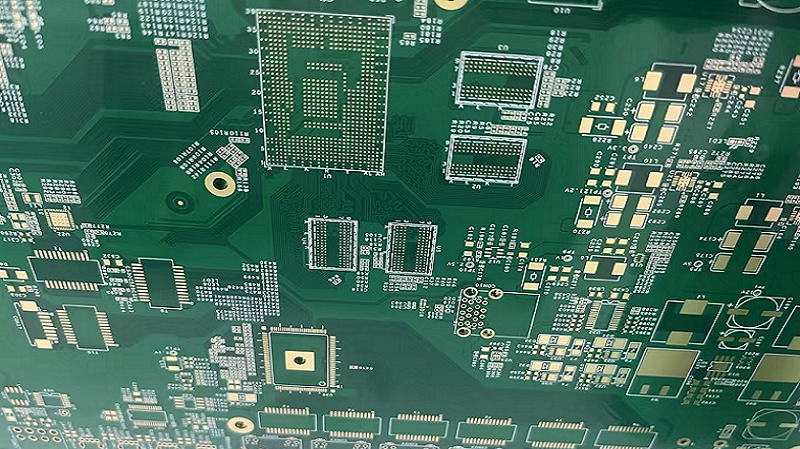
High-speed PCB material selection directly dictates signal integrity, manufacturing yield, and long-term reliability—especially for hdi pcb, Low Loss PCB, and ultra low loss pcb applications. This guide breaks down key material properties (Dk/Df, Tg, CAF resistance), compares mainstream laminates (FR-4, PTFE, hydrocarbon), and provides factory-proven selection criteria aligned with IPC standards and real-world production constraints.
Learn more about: What Is High-Speed PCB? A Comprehensive Guide
Technical Points
1. High-speed PCB Materials
Core Material Properties
- Dielectric Constant (Dk): Stable ±0.1 @10GHz (critical for impedance control ±5%)
- Dissipation Factor (Df): ≤0.006 (Low Loss PCB); ≤0.002 (ultra low loss pcb)
- Glass Transition Temperature (Tg): ≥135°C (standard); ≥170°C (automotive/industrial hdi pcb)
- CAF Resistance: IPC-TM-650 2.6.25 Class 3 (no conductive anodic filament growth at 85°C/85% RH)
- Thermal Decomposition Temperature (Td): ≥320°C (compatible with lead-free reflow 260°C peak)
Material Classification by Performance
- Standard FR-4: Dk 4.2–4.5 @10GHz, Df 0.012–0.018 (≤1Gbps high speed pcb)
- High-Speed Laminates: Dk 3.4–3.8 @10GHz, Df 0.005–0.008 (1–25Gbps, Low Loss PCB)
- Ultra Low Loss: Dk 2.9–3.3 @10GHz, Df ≤0.002 (≥25Gbps, ultra low loss pcb)
- HDI-Optimized: Low CTE (X/Y ≤16ppm/°C) for microvia reliability (0.1–0.15mm diameter)
2. High-Speed PCB vs. Normal PCB Materials
Key Property Differences
| Aspect | High Speed PCB | Normal PCB |
|---|---|---|
| Dk Stability | ±0.1 @10GHz | ±0.3 @1GHz |
| Df @10GHz | ≤0.006 | ≤0.018 |
| Tg Minimum | 170°C | 135°C |
| CAF Resistance | IPC Class 3 | IPC Class 1/2 |
| CTE X/Y | ≤16ppm/°C | ≤20ppm/°C |
Manufacturing Impact
- High speed pcb: Tighter dielectric thickness tolerance (±10% vs. ±15% for normal PCB)
- hdi pcb: Sequential lamination compatible (max 4 cycles) vs. 2 cycles for normal PCB
- ultra low loss pcb: Laser drilling only (0.1mm microvias) vs. mechanical drilling for normal PCB
- Impedance control: ±2% (high speed pcb) vs. ±10% (normal PCB) per IPC-6012
3. High-Speed PCB Material Comparison
Material Performance Matrix
| Material Type | Dk @10GHz | Df @10GHz | Tg (°C) | CAF Resistance | Cost vs. FR-4 | Best For |
|---|---|---|---|---|---|---|
| Standard FR-4 | 4.2–4.5 | 0.012–0.018 | 135–150 | Class 1 | 1x | ≤1Gbps high speed pcb |
| High-Speed FR-4 (FR408HR) | 3.48–3.67 | 0.0093–0.0098 | 180 | Class 2 | 1.5x | 1–10Gbps hdi pcb |
| PTFE/Ceramic (Rogers 4350B) | 3.48 | 0.0017 | 180 | Class 3 | 4x | ≥25Gbps ultra low loss pcb |
| PPE/PPO Hydrocarbon (Megtron 7) | 3.38 | 0.0025 | 200 | Class 3 | 3x | 10–50Gbps Low Loss PCB |
| PPE/PPO Hydrocarbon (Megtron 8) | 3.28 | 0.0019 | 220 | Class 3 | 5x | ≥50Gbps ultra low loss pcb |
Learn more about: Materials for HDI PCB: Full Classification Guide
Material-Specific Characteristics
- Standard FR-4: Cost-effective but high loss; limited to low-speed high speed pcb (≤1Gbps)
- High-Speed Laminates (FR408HR): Balanced performance for mid-range hdi pcb (1–10Gbps)
- PTFE/Ceramic-Filled PTFE: Ultra-low loss but high cost; requires specialized lamination for hdi pcb
- PPE/PPO Hydrocarbon: High Tg + low loss; ideal for automotive/industrial Low Loss PCB (10–50Gbps)
4. Material Selection Factors
Electrical & Thermal Requirements
- Data rate matching: 1–10Gbps → High-Speed FR-4; ≥25Gbps → ultra low loss pcb (PTFE/hydrocarbon)
- Temperature range: -40°C to 125°C → Tg ≥170°C (automotive hdi pcb)
- Impedance target: 50Ω (single-ended) → Dk 3.4–3.8; 100Ω (differential) → Dk 2.9–3.3
- Thermal cycling: 1000 cycles (-40°C/125°C) → CAF Resistance Class 3
Manufacturing & Cost Constraints
- Lamination compatibility: Sequential lamination (hdi pcb) → PPE/PPO (vs. PTFE’s poor bond strength)
- Drillability: Microvias (0.1–0.15mm) → Laser-drillable materials (hydrocarbon/FR408HR)
- Cost balance: ultra low loss pcb (PTFE) = 4–5x FR-4; Low Loss PCB (hydrocarbon) = 3x FR-4
- Lead time: PTFE (6–8 weeks) vs. High-Speed FR-4 (2–3 weeks) for hdi pcb production
5. Common Material Recommendations
Application-Specific Selections
- Consumer Electronics (smartphones): hdi pcb → High-Speed FR-4 (FR408HR), Tg 180°C
- Data Center (25Gbps): Low Loss PCB → Megtron 7 (PPE/PPO), Df 0.0025
- Aerospace/Defense (50Gbps): ultra low loss pcb → Rogers 4350B (PTFE), Df 0.0017
- Automotive ADAS: hdi pcb → Megtron 8 (PPE/PPO), Tg 220°C, CAF Class 3
HDI-Specific Recommendations
- Microvia aspect ratio ≤0.75:1 → Materials with low CTE (≤16ppm/°C)
- Via-in-Pad (VIP) → Copper-filled compatible (hydrocarbon/FR408HR vs. PTFE)
- Sequential lamination → No PTFE (poor interlayer adhesion); use PPE/PPO or high-speed FR-4
- Trace/space 2.5/2.5mil → Dielectric thickness 4mil (impedance 50Ω)
6. Early Fabrication Involvement
Pre-Design Validation
- Material availability check: ultra low loss pcb (Megtron 8) lead time 4–6 weeks
- Lamination cycle review: hdi pcb sequential lamination (max 4 cycles) compatibility
- Drill capability verification: Laser drilling for 0.1mm microvias (PTFE/hydrocarbon)
- Test coupon design: Include impedance (50Ω/100Ω) and thermal cycling structures
DFM Alignment
- Material thickness tolerance: ±10% (critical for impedance control in high speed pcb)
- Copper weight matching: 1oz outer/0.5oz inner (balances flexibility for hdi pcb)
- Reflow profile validation: 260°C peak (compatible with Tg ≥170°C materials)
- Pre-bake requirements: 125°C for 4 hours (moisture content ≤0.15% for hdi pcb)
7. Surface Finish and Testing
Finishes for High-Speed Materials
- ENIG: Ni 3–6μm, Au 0.05–0.15μm (general high speed pcb/hdi pcb)
- ENEPIG: Ni 3–6μm, Pd 0.1–0.2μm, Au 0.05μm (ultra low loss pcb fine-pitch BGAs)
- Immersion Silver: 0.8–1.2μm (cost-effective Low Loss PCB)
- Compliance: IPC-4552 (ENIG), IPC-4556 (ENEPIG)
Material Quality Testing
- Dk/Df Verification: Vector Network Analyzer (VNA) @10GHz (±0.01 Dk, ±0.0005 Df)
- Thermal Cycling: -40°C to 125°C, 1000 cycles (no microvia cracking in hdi pcb)
- CAF Testing: IPC-TM-650 2.6.25 (1000 hours @85°C/85% RH, no failure)
- Impedance Testing: TDR ±2% tolerance (50Ω single-ended, 100Ω differential)
8. Fabrication Guidelines
Annular Rings & Board Edge
- Outer layer annular ring: ≥2mil (Class 2); ≥3mil (Class 3) for high speed pcb
- Inner layer annular ring: ≥1.5mil (Class 2); ≥2mil (Class 3) for hdi pcb
- Board edge clearance: 15mil (traces); 20mil (vias) for ultra low loss pcb
- Depaneling: Laser depaneling (vs. V-score) for ultra low loss pcb (reduces edge stress)
Data Package Requirements
- Gerber X2 files: Layer stack with material type/thickness per layer
- Material spec sheet: Dk/Df, Tg, CTE, and CAF resistance data
- Fabrication notes: IPC class (2/3), surface finish, and microvia specifications (0.1–0.15mm)
- Test plan: Impedance, thermal cycling, and CAF testing requirements
9. Key Comparison Tables
Megtron 7 vs. Megtron 8 (Ultra Low Loss PCB)
| Aspect | Megtron 7 | Megtron 8 |
|---|---|---|
| Dk @10GHz | 3.38 | 3.28 |
| Df @10GHz | 0.0025 | 0.0019 |
| Tg (°C) | 200 | 220 |
| Cost vs. FR-4 | 3x | 5x |
| Max Data Rate | 50Gbps | 112Gbps |
PTFE vs. PPE/PPO Hydrocarbon (Low Loss PCB)
| Aspect | PTFE/Ceramic | PPE/PPO Hydrocarbon |
|---|---|---|
| Df @10GHz | 0.0017 | 0.0019–0.0025 |
| CAF Resistance | Class 3 | Class 3 |
| HDI Compatibility | Poor (adhesion) | Excellent |
| Manufacturing Cost | 4x FR-4 | 3x FR-4 |
| Lead Time | 6–8 weeks | 4–6 weeks |
Factory Case Study
12-Layer HDI Ultra Low Loss PCB for 50Gbps Telecom
Project Specifications
- Layer structure: 2+8+2 hdi pcb stackup (12-layer high speed pcb)
- Materials: Megtron 7 (Low Loss PCB), Tg 200°C, Dk 3.38, Df 0.0025
- Parameters: 50Ω single-ended, 100Ω differential; 3mil/3mil trace/space; 0.12mm microvias
- Application: 50Gbps telecom transceiver (ultra low loss pcb requirement)
Issues Encountered
- Incorrect material selection (standard FR-4 instead of Megtron 7) → insertion loss >0.5dB/inch @20GHz
- CAF failure (IPC Class 2 material) → 18% open circuits after 500 thermal cycles
- Microvia cracking (CTE mismatch 5ppm/°C) → 22% yield loss
- Dielectric thickness tolerance ±15% → impedance variation ±8% (failed IPC Class 3)
Improvements Implemented
- Switched to Megtron 7 (Low Loss PCB) → insertion loss reduced to 0.2dB/inch @20GHz
- Upgraded to IPC Class 3 CAF-resistant material → 0% CAF failures
- Matched core/buildup CTE (≤2ppm/°C difference) → microvia cracking <1%
- Tightened dielectric tolerance to ±10% → impedance variation ±2% (meets Class 3)
- Pre-production DFM review with fabrication team (early material validation)
Results
- Yield improved from 65% to 94%
- Insertion loss reduced by 60% (0.2dB/inch @20GHz)
- Thermal cycle failure rate (1000 cycles) reduced from 22% to 1%
- Impedance compliance rate 100% (IPC Class 3)
- Production lead time optimized by 10 days (early material alignment)
Common Design Errors
- Using standard FR-4 for >10Gbps signals (Df too high → insertion loss >0.5dB/inch @20GHz)
- Ignoring CAF resistance (IPC Class 1 material) → 18% open circuits in hdi pcb after environmental testing
- CTE mismatch (>3ppm/°C) between core/buildup layers → microvia cracking in ultra low loss pcb
- Inadequate annular rings (<1.5mil) → 25% via breakout during drilling for high speed pcb
- Late material validation → 4–6 week delays for ultra low loss pcb (Megtron 8) availability
- Overlooking dielectric thickness tolerance (±15%) → impedance variation ±8% (failed Class 3)
- Using PTFE for sequential lamination hdi pcb → poor interlayer adhesion (15% delamination)
- Missing material spec in data package → misfabrication (wrong Dk material for impedance target)
FAQ
1. When should I choose ultra low loss pcb over Low Loss PCB for hdi pcb?
ultra low loss pcb (Df ≤0.002) is required for data rates ≥25Gbps, trace lengths >6 inches, or frequencies >20GHz in hdi pcb designs. Low Loss PCB (Df 0.003–0.006) is cost-effective for 1–25Gbps signals, balancing performance and manufacturing costs for most hdi circuit boards.
2. How to validate high speed pcb material performance before production?
Conduct pre-production testing with test coupons: verify Dk/Df via VNA @10GHz, perform thermal cycling (-40°C/125°C, 1000 cycles) for microvia reliability, test CAF resistance per IPC-TM-650, and validate impedance with TDR (±2% tolerance). Early collaboration with fabricators confirms material manufacturability for hdi pcb.
3. What are the key fabrication constraints for ultra low loss pcb (PTFE/hydrocarbon)?
ultra low loss pcb requires laser drilling (0.1–0.15mm microvias), tight dielectric thickness tolerance (±10%), laser depaneling (reduces edge stress), and specialized lamination (low pressure for PTFE) to avoid delamination. For hdi pcb, PPE/PPO hydrocarbon is preferred over PTFE for sequential lamination compatibility.
If you need high speed PCB manufacturing or design support,our engineering team provides free DFM analysis and quotation.

![Understanding PCB Costs & Pricing [Your Complete Guide]](https://hdicircuitboard.com/wp-content/uploads/elementor/thumbs/Understanding-PCB-Costs-Pricing-Your-Complete-Guide-qzzhe6mcaxuolkux3xalfktgavumi9y1aqfbs9bpv4.webp "Understanding PCB Costs & Pricing [Your Complete Guide]")