







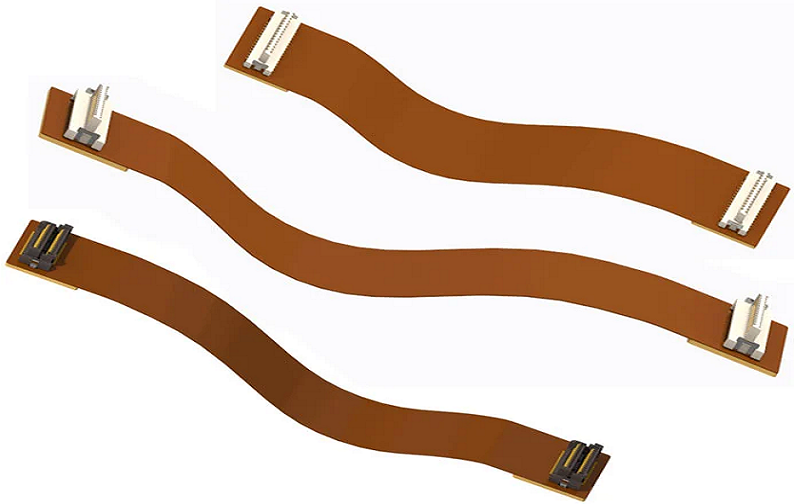
Flexible PCB connectors and stiffeners form critical mechanical and electrical interfaces for bendable circuit boards, requiring precise material selection, dimensional control, and manufacturing compliance. This factory-verified guide covers connector types (ZIF, FFC, FPC), pitch specifications, contact systems, stiffener materials (FR4, polyimide, metal), thickness parameters, adhesive systems, and IPC-aligned quality requirements for reliable rigid-flex PCB and flexible printed circuit board assemblies.
Learn more about: Flexible PCB Design Guidelines
Flexible PCB Connector Fundamentals
Common Flex PCB Connector Types
- ZIF (Zero Insertion Force) Connectors
- Pitch sizes: 0.3mm, 0.4mm, 0.5mm, 1.0mm standard
- Actuation: Flip-top, slide-lock, flip-lock mechanisms
- Insertion force: <0.2N per contact (IPC-2223 Class 2)
- Contact plating: 0.1μm gold over 2μm nickel
- Cycles: 500+ mating operations
- Applications: Consumer electronics, medical devices
- Non-ZIF Connectors
- Pitch options: 0.5mm, 1.0mm, 1.25mm, 2.0mm
- Insertion force: 1.5-3.0N per contact
- Retention force: >5N per contact
- Cost: 30-40% lower than ZIF equivalents
- Applications: Industrial controls, automotive interiors
- FPC (Flexible Printed Circuit) Connectors
- Low-profile designs: 0.6mm, 0.8mm, 1.2mm height
- Circuit counts: 4-60 contacts
- Orientation: Vertical, right-angle, horizontal
- Temperature range: -40°C to +105°C
- Compliance: RoHS, REACH, UL94 V-0 flammability
- FFC (Flexible Flat Cable) Connectors
- Pitch standards: 0.5mm, 1.0mm, 1.25mm
- Cable compatibility: 0.12-0.20mm thickness
- Contact style: Flat blade, bifurcated contacts
- SMT termination: 100% reflow compatible
- Applications: Display interfaces, internal connections
Connector Key Characteristics
- Contact Styles
- Flat blade: 0.15mm thickness, 2-3 points contact
- Bifurcated: Dual contact points, redundancy design
- Post-type: Through-hole mounting, high retention
- Press-fit: No solder required, 30N retention force
- Actuator Types
- Flip-top: 90° rotation, quick operation
- Slide-lock: Linear motion, space-efficient
- Flip-lock: Dual-action, secure retention
- Push-lock: One-touch operation, high vibration resistance
- Pitch Specifications
- High-density: 0.3mm, 0.4mm pitch (smartphones)
- Standard: 0.5mm pitch (consumer electronics)
- Power: 1.0mm, 1.25mm pitch (industrial)
- Automotive: 2.0mm pitch (high-current applications)
Flex PCB Stiffener Systems
Key Stiffener Types and Materials
- FR4 Stiffeners
- Thickness range: 0.1mm, 0.2mm, 0.3mm, 0.4mm, 0.5mm
- Dielectric constant: 4.4 ± 0.1 (1MHz)
- Temperature resistance: -50°C to +130°C
- Bonding: Thermal-set adhesive (180°C cure)
- Applications: SMT component areas, connector interfaces
- Polyimide (PI) Stiffeners
- Thickness options: 25μm, 50μm, 75μm, 100μm, 125μm
- Temperature range: -65°C to +220°C
- Flexibility: 30% elongation at break
- Adhesive: Acrylic PSA (pressure-sensitive)
- Applications: Dynamic bending zones, high-temperature areas
- Aluminum Stiffeners
- Thickness: 0.1mm, 0.15mm, 0.2mm
- Thermal conductivity: 205 W/mK
- Weight: 2.7 g/cm³ (30% lighter than steel)
- Surface treatment: Anodized, conductive coating
- Applications: Heat dissipation, EMI shielding
- Stainless Steel Stiffeners
- Alloy: 301, 304, 316 grades
- Thickness: 0.05mm, 0.1mm, 0.15mm, 0.2mm
- Tensile strength: 520-720 MPa
- Corrosion resistance: Salt spray tested 72+ hours
- Applications: High-strength areas, connector backs
Stiffener Applications and Uses
- ZIF Connectors (Gold Fingers)
- Stiffener extension: 2.0-3.0mm beyond contact area
- Thickness: 0.2-0.3mm FR4 or stainless steel
- Alignment tolerance: ±0.05mm
- Bevel requirement: 45° edge, 0.3mm chamfer
- Component Support
- Coverage: 100% under SMD components
- Extension: 0.5mm beyond component perimeter
- Thickness: 0.1-0.2mm based on component weight
- Avoid: Coverage over component terminations
- Area Strengthening
- Panel rigidity: 0.3mm FR4 for assembly processing
- Bend prevention: Stiffeners placed 1.0mm from bend lines
- Transition support: 3-5mm length at rigid-flex interfaces
- Warpage control: Symmetric placement on both sides
Typical Stiffener Thicknesses
- Polyimide (PI)
- Ultra-thin: 25μm, 50μm (dynamic flex)
- Standard: 75μm, 100μm (general purpose)
- Heavy-duty: 125μm, 150μm (high stress)
- Rigid Materials (FR4/Metal)
- FR4: 0.1mm, 0.2mm, 0.3mm, 0.4mm, 0.5mm
- Aluminum: 0.1mm, 0.15mm, 0.2mm
- Stainless steel: 0.05mm, 0.1mm, 0.15mm, 0.2mm
Adhesive Options
- Pressure Sensitive Adhesive (PSA)
- Type: Acrylic, silicone formulations
- Thickness: 25μm, 50μm
- Bond strength: 8-12 N/cm (180° peel)
- Temperature: -40°C to +125°C
- Application: Room temperature bonding
- Thermal Set Adhesive
- Type: Epoxy, modified acrylic
- Cure conditions: 160-180°C, 60-90 minutes
- Bond strength: 15-20 N/cm
- Temperature resistance: -55°C to +150°C
- Applications: High-reliability, high-temperature
Learn more aobut: Flexible PCB Materials Guide: Polyimide and LCP for High-Performance Designs
Critical Parameter Comparisons
Connector Type Comparison
| Parameter | ZIF Connector | Non-ZIF Connector | FFC Connector |
|---|---|---|---|
| Pitch | 0.3-1.0mm | 0.5-2.0mm | 0.5-1.25mm |
| Insertion Force | <0.2N | 1.5-3.0N | 1.0-2.5N |
| Cycles | 500+ | 150+ | 300+ |
| Cost | High | Medium | Low |
| Profile | 0.6-1.2mm | 1.0-2.0mm | 0.8-1.5mm |
Stiffener Material Comparison
| Property | FR4 | Polyimide | Aluminum | Stainless Steel |
|---|---|---|---|---|
| Thickness | 0.1-0.5mm | 25-150μm | 0.1-0.2mm | 0.05-0.2mm |
| Temp Range | -50 to +130°C | -65 to +220°C | -60 to +150°C | -70 to +200°C |
| Strength | High | Medium | Very High | Extreme |
| Weight | Medium | Light | Light | Heavy |
| Cost | Low | Medium | High | Very High |
Core Technical Parameters
Connector Design Specifications
- Contact Plating: 0.1μm Au over 2μm Ni (minimum)
- Width/Spacing: 0.18mm/0.12mm (0.3mm pitch)
- Bend Radius: 5× thickness at connector interface
- Clearance: 0.5mm minimum from stiffener edge to via
- Layer Count: 1-4 layers in connector termination area
- Impedance Control: 90Ω ±10% (differential pairs)
Stiffener Design Rules
- Coverage Accuracy: ±0.05mm placement tolerance
- Edge Treatment: 0.3mm minimum radius at corners
- Overlap: 0.8-1.2mm onto flexible substrate
- Thickness Matching: ±0.02mm across panel
- Transition: 45° angle at stiffener termination
- IPC Standard: IPC-4101E for stiffener materials
Quality Control and Compliance
IPC Standards Alignment
- IPC-2223: Sectional design standard for flexible PCBs
- IPC-6013: Qualification and performance specification
- IPC-4101: Base material requirements
- IPC-TM-650 2.4.1: Adhesion strength testing
- IPC-TM-650 2.4.3: Bend cycle reliability testing
Manufacturing Verification
- Connector Verification
- Contact resistance: <30 milliohms per contact
- Insertion force monitoring: 100% inline inspection
- Retention force: >5N minimum pull resistance
- Solderability: 95% coverage per IPC-J-STD-004
- Stiffener Quality Control
- Bond strength: 15N/cm minimum peel strength
- Dimensional accuracy: CMM verification ±0.02mm
- Thermal stability: <0.1% dimensional change @150°C
- Visual inspection: 100% for delamination, bubbles
Case Study
Project Specifications
- Product: Wearable medical device flex assembly
- Configuration: 4-layer rigid-flex PCB
- Dimensions: 65mm × 12mm, flex thickness 0.12mm
- Requirements: 10,000 bend cycles, -20°C to +60°C
Initial Design Issues
- Problem 1: Connector separation after 2,500 cycles
- Problem 2: Stiffener delamination during reflow
- Problem 3: Trace cracking at stiffener transition
Engineering Solutions
- Upgraded from 0.1mm to 0.2mm stainless steel stiffener
- Extended stiffener 2.5mm beyond connector contacts
- Implemented 0.5mm radius at all stiffener corners
- Changed from PSA to thermal-set adhesive system
- Added teardrop transitions at stiffener boundaries
Final Results
- Bend Life: 12,500+ cycles (25% above specification)
- Production Yield: 97.6% (improved from 72%)
- Field Reliability: 0.02% failure rate (12-month data)
- Assembly Efficiency: 40% reduction in handling damage
Common Design Errors
- Insufficient Stiffener Length: 68% of connector failures (under 2mm extension)
- Wrong Material Selection: 54% of delamination issues (PI in high-temperature zones)
- Incorrect Adhesive Type: 47% of bond failures (PSA for thermal applications)
- Sharp Stiffener Corners: 41% of trace cuts (radius <0.3mm)
- Inadequate Clearance: 36% of electrical shorts (via <0.5mm from edge)
- Asymmetric Stiffening: 32% of warping issues (unbalanced coverage)
- Pitch Mismatch: 29% of connection problems (connector-board mismatch)
- Insufficient Plating: 27% of contact failures (gold <0.1μm thickness)
Frequently Asked Questions
Q: What stiffener thickness is recommended for FPC connectors?
A: For ZIF connectors, use 0.2-0.3mm FR4 or 0.15mm stainless steel stiffeners extending 2.0-3.0mm beyond contact areas. Factory standards require ±0.05mm placement accuracy and 0.3mm minimum corner radius for reliable performance.
Q: What is the difference between FPC and FFC connectors?
A: FPC connectors mate with etched flexible printed circuits (0.3-0.5mm pitch), while FFC connectors work with flat flexible cables (0.5-1.25mm pitch). FPC offers higher density and custom routing; FFC provides lower cost for standardized interconnections.
Q: When should thermal-set vs. PSA adhesive be used?
A: Use thermal-set adhesive for high-temperature applications (+125°C) and high-reliability requirements. PSA works for room-temperature applications with moderate temperature exposure (-40°C to +85°C), offering simpler processing but lower bond strength.
Q: What pitch size should be selected for flexible PCB connectors?
A: Select 0.3mm pitch for high-density consumer electronics, 0.5mm pitch for general applications, and 1.0mm pitch for power or industrial use. Always verify pitch compatibility with mating connectors to prevent assembly issues.
If you need professional flexible circuit board design support or quotation, our team provides free DFM check and fast turnaround.

![Understanding PCB Costs & Pricing [Your Complete Guide]](https://hdicircuitboard.com/wp-content/uploads/elementor/thumbs/Understanding-PCB-Costs-Pricing-Your-Complete-Guide-qzzhe6mcaxuolkux3xalfktgavumi9y1aqfbs9bpv4.webp "Understanding PCB Costs & Pricing [Your Complete Guide]")