







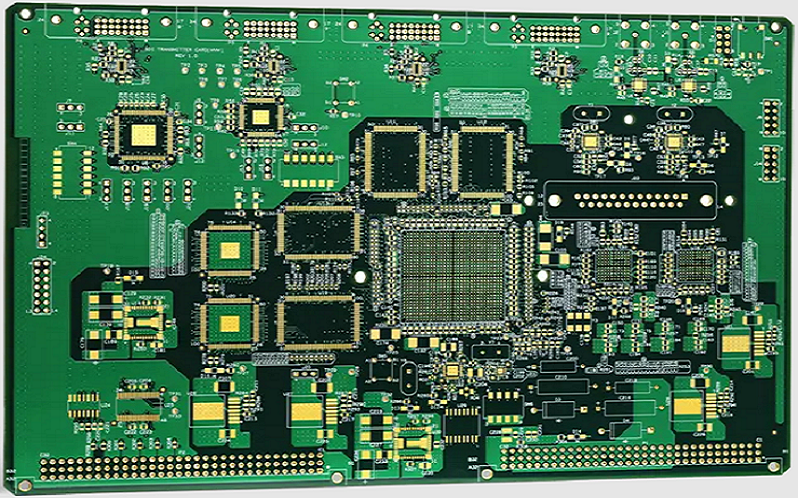
HDI PCB fabrication capabilities define what a factory can repeatedly manufacture across trace width, spacing, laser microvias, via-in-pad, sequential build-up, material systems, dielectric thickness, impedance control, copper balance, and inspection. For engineers, capability is not a brochure number. It is the stable process window that decides whether an hdi pcb prototype can move into production without microvia cracking, VIP voiding, layer shift, impedance drift, warpage, or low final yield.
Capability Window
Industry Standard Capabilities
HDI fabrication starts with measurable limits. A practical capability review should separate stable production values from engineering-limit values.
| Capability Area | Stable HDI Range | Advanced / Ultra HDI Range | Factory Check |
|---|---|---|---|
| Trace width / space | 75/75 microns | 50/50 to 25/25 microns | AOI, etch factor, copper thickness |
| Laser microvia | 75-125 microns | 50-75 microns | Laser quality, plating, microsection |
| Build-up dielectric | 50-80 microns | 25-50 microns | Lamination control, via aspect ratio |
| Mechanical drill | 0.20-0.30 mm | 0.15-0.20 mm | Drill wander, plating thickness |
| Impedance tolerance | ±10% common | ±5% by review | Coupon design and TDR test |
| VIP dimple | Below 10-15 microns | Below 10 microns | Planarity, X-ray, cross-section |
| Copper thickness | 9-18 microns for fine lines | 35 microns for power areas | Etching margin and current capacity |
IPC-2226 is the sectional design standard for high density interconnect printed boards, while IPC-2221 provides general design requirements. IPC-6012 defines qualification and performance requirements for rigid printed boards, including multilayer boards with blind and buried vias.
Capability vs Limit
A factory’s “minimum” does not always mean “safe for production.” A 50/50 micron trace pattern may be acceptable on 12 micron copper in a small BGA region, but the same rule across a large panel with 35 micron copper can reduce yield.
| Engineering Question | Capability Number Alone | Production Capability View |
|---|---|---|
| Can the factory make 50/50 microns? | Yes or no | On which copper thickness, panel size, and yield target? |
| Can it make microvias? | Yes or no | Which diameter, dielectric depth, fill type, and reliability test? |
| Can it make VIP? | Yes or no | What dimple limit, cap thickness, and X-ray rule? |
| Can it control impedance? | Yes or no | Which layers, material, tolerance, and coupon geometry? |
| Can it build Ultra HDI? | Yes or no | SAP, mSAP, equipment, metrology, and process Cpk? |
Key Manufacturing Processes
Laser Microvias
Laser microvias create short vertical connections between adjacent HDI layers. They support fine-pitch BGA escape, shorter signal paths, and reduced via stubs.
Factory controls:
- Laser via diameter: 75-125 microns for common HDI
- Advanced via diameter: 50-75 microns by process review
- Dielectric depth: 50-80 microns for stable aspect ratio
- Aspect ratio: normally at or below 1:1
- Capture pad: commonly 200-300 microns
- Inspection: AOI, E-test, X-ray sampling, and microsection
Laser quality is checked by via shape, residue removal, copper adhesion, plating continuity, and thermal stress behavior. A microvia can pass room-temperature continuity and still fail after thermal cycling if plating is thin or the dielectric depth is too aggressive.
Via-in-Pad and Filling
Via-in-pad places a via inside a component pad. VIPPO fills and caps the via to create a flat solderable surface. It is common in high density interconnect designs with 0.5 mm or 0.4 mm BGA, compact power delivery, and dense decoupling.
| VIP Process Item | Target Range | Failure Prevented |
|---|---|---|
| Via fill | Solid copper or qualified conductive / nonconductive fill | Solder wicking |
| Cap plating | Continuous plated cap | Exposed via cavity |
| Dimple | Below 10-15 microns | Uneven BGA solder joint |
| Planarity | Verified before mask | Tilted component seating |
| X-ray | VIP and BGA areas | Hidden voids |
Via filling is not only an electrical step. It is an assembly step. Poor filling can create solder voids, weak BGA joints, and reflow defects.
Sequential Build-Up
Sequential Build-Up, or SBU, adds HDI layers in repeated cycles. Each cycle adds dielectric, laser drilling, plating, imaging, etching, and inspection.
SBU process flow:
- Core Creation
The factory builds the inner core, drills buried vias if needed, plates holes, and verifies inner-layer registration. - First Sequential Lamination
Build-up dielectric and copper foil are laminated over the core. Material movement is measured because shrinkage affects microvia alignment. - Microvia Drilling and Plating
Laser microvias are drilled, cleaned, plated, and sometimes copper-filled. - Repetition
The factory repeats lamination, drilling, plating, and etching for 2+N+2, 3+N+3, any-layer, or ELIC constructions. - Final Surface Process
Solder mask, surface finish, routing, E-test, AOI, X-ray, microsection, and impedance testing complete the lot.
Sequential lamination adds routing freedom but also adds registration movement. Each build-up cycle increases the need for coupon control and process discipline.
SBU Construction Types
Type I to Type III
HDI Type I, Type II, and Type III are used to classify common build-up structures. Type I generally uses one microvia build-up layer. Type II includes additional via structures and higher density. Type III uses multiple build-up layers and supports more complex routing.
| SBU Type | Common Structure | Typical Use | Manufacturing Load |
|---|---|---|---|
| Type I | 1+N+1 | 0.65 mm BGA, compact consumer or industrial boards | Lower |
| Type II | 2+N+2 | 0.5 mm BGA, dense modules, high-speed designs | Medium |
| Type III | 3+N+3 | Processors, AI modules, compact communication boards | High |
| Any-layer HDI | Microvia access across many layers | Extreme density and short vertical paths | Very high |
| ELIC | Every Layer Interconnect | Dense BGA, chip-scale, advanced modules | Highest |
Type Selection Logic
A lower SBU type is not weaker if it meets the routing need. Type I is often better for cost and yield when package pitch allows it. Type II fits many dense BGA layouts. Type III, any-layer, and ELIC should be used when escape routing, signal path length, or board size cannot be solved with simpler structures.
Material Considerations
High-Tg and Advanced Laminates
Material choice affects drilling, plating, lamination movement, impedance, thermal reliability, and final assembly yield.
| Material Category | Typical Use | Engineering Control |
|---|---|---|
| High-Tg FR-4 | Industrial HDI, moderate-speed products | Tg, Z-axis expansion, reflow margin |
| Low Dk / low Df laminate | High-speed, RF, AI, networking | Loss budget, copper roughness, impedance |
| Thin build-up dielectric | Microvia formation | Dielectric depth and resin flow |
| Low-profile copper | High-speed and fine lines | Reduced conductor loss |
| Flexible polyimide | Flex and rigid-flex HDI | Bend radius, adhesive system, copper type |
| Advanced substrate-like materials | Ultra HDI | SAP / mSAP compatibility |
High-Tg FR-4 is often enough for compact industrial HDI. Low-loss laminates become important when insertion loss, skew, or high-speed interface margin drives the design.
Flexible and Rigid-Flex HDI
Flexible and rigid-flex HDI adds another layer of capability review. The factory must check copper ductility, coverlay registration, bend area copper, stiffener bonding, and transition-zone strain.
Rigid-flex HDI review points:
- Flex layer copper: 12-18 microns common for bend regions
- Bend radius: often 6x to 10x flex thickness depending on duty
- Coverlay opening tolerance: project-specific, commonly 0.10-0.20 mm design clearance
- Stiffener thickness: commonly 0.10-0.30 mm by mechanical need
- Transition zone: no vias or components near bend start
- Dynamic bending: requires separate cycle test
Ultra HDI PCB Fabrication
Core Capabilities
Ultra HDI moves beyond standard HDI by using finer conductor geometry, smaller vias, thinner dielectric, and tighter metrology. Semi-additive processing supports much finer features; SAP can enable traces at 25 microns or below, and mSAP commonly targets around 30 micron trace / space ranges depending on the fabricator and process stack.
| Ultra HDI Capability | Standard HDI | Ultra HDI Range |
|---|---|---|
| Trace / space | 75/75 to 50/50 microns | 30/30 to 25/25 microns, lower by qualification |
| Microvia | 75-100 microns | 50-75 microns |
| Dielectric thickness | 50-80 microns | 25-50 microns |
| Imaging method | Subtractive etch | SAP / mSAP / advanced fine-line process |
| Main use | Fine-pitch BGA and dense modules | Chiplet fanout, advanced AI, medical, aerospace |
SAP and mSAP
SAP and mSAP reduce the subtractive etching burden. Instead of etching thick copper down to a fine conductor, the process starts with very thin copper and plates the conductor pattern with tighter geometry control.
Manufacturing value:
- Better control of fine lines
- Less trapezoidal conductor shape than conventional etch
- Better spacing control for dense fanout
- Potentially tighter impedance variation
- Better support for 25-30 micron routing
Manufacturing risk:
- Requires dedicated process chemistry
- Requires stronger surface preparation
- Requires tighter cleanliness control
- Can be sensitive to final finish thickness
- Needs metrology beyond standard HDI inspection
Licensable Technologies
Some Ultra HDI processes are tied to licensed semi-additive technologies, specialized chemistry, or equipment sets. For engineers, the important point is not the license name. It is whether the hdi pcb manufacturer can show stable yield, line width data, plating uniformity, peel strength, and inspection records for the exact geometry being quoted.
Signal Integrity and Substrates
Controlled Impedance
Controlled impedance is a fabrication capability, not only a design rule. The factory must control dielectric thickness, copper thickness, etch profile, plating thickness, and final finish.
Common targets:
| Signal Type | Typical Impedance | Fabrication Control |
|---|---|---|
| Single-ended clock | 50 ohm | Trace width, dielectric, reference plane |
| PCIe differential | 85 ohm | Pair geometry, via transition, material loss |
| USB differential | 90 ohm | Spacing, solder mask, routing layer |
| Ethernet / LVDS | 100 ohm | Plane continuity and coupon geometry |
| RF control | 50 ohm | Low-loss material and copper roughness |
A controlled impedance note without coupon structure is incomplete. The coupon must represent the real layer, dielectric, copper thickness, and solder mask condition.
Copper Balance
Copper balance controls lamination stability and warpage. HDI boards with uneven copper density may twist after lamination or reflow.
Copper balance controls:
- Match copper density on opposing layers.
- Add copper thieving outside controlled impedance areas.
- Avoid large copper islands on one side only.
- Balance high-current planes with reference planes.
- Check warpage after reflow simulation.
- Review copper density before panelization.
Copper balance becomes more important as layer count, board size, copper weight, and BGA package size increase.
Benchuang Electronics Capability
HDI Fabrication Capability
Benchuang Electronics should be positioned as an hdi pcb manufacturer for dense multilayer boards, fine-pitch structures, HDI prototype builds, and pilot-to-production transfer. Public company information describes Benchuang as a PCB manufacturer focused on high-end HDI and multilayer PCB manufacturing, with DFM support, turnkey PCBA capability, and annual HDI production capacity stated at 480,000 square meters.
For HDI PCB Fabrication Capabilities, the stronger engineering value is the factory review process:
- Can the stackup move from prototype to volume?
- Can the microvia geometry survive thermal stress?
- Can via-in-pad meet flatness and fill requirements?
- Can impedance coupons represent real routing?
- Can the process hold line width after panel compensation?
- Can the factory inspect stacked microvias by microsection?
- Can assembly feedback be linked back to bare-board process data?
Uploaded Fine-Pitch Capability
The uploaded Benchuang fine-pitch document shows 0.065 mm annular ring, 0.075 mm micro via hole, 0.205 mm via land, 0.325 mm plane clearance, solder mask values around 0.20 mm to 0.275 mm, and track examples including 0.05 mm. These values help engineers review fine-pitch HDI routing, via land planning, solder mask clearance, and capability fit before ordering.
| Capability Item | Uploaded Value | Engineering Use |
|---|---|---|
| Annular ring | 0.065 mm | Via registration margin |
| Micro via hole | 0.075 mm | Fine via planning checkpoint |
| Via land | 0.205 mm | Capture pad reference |
| Plane clearance | 0.325 mm | Inner-layer clearance review |
| Solder mask | 0.20-0.275 mm | Mask registration discussion |
| Track examples | 0.05 mm | Fine-line routing reference |
These values should be verified against each project’s copper thickness, layer count, finish, solder mask, impedance target, and production quantity.
Manufacturing Benefits
High-Density Interconnects
HDI fabrication reduces routing area by replacing large through vias with microvias, blind vias, buried vias, and via-in-pad. This allows dense BGA packages, shorter routes, better escape routing, and smaller board outlines.
Benefits:
- Higher component density
- Smaller PCB outline
- Shorter signal routes
- Lower via stub
- Better BGA breakout
- More room for power and ground planes
- Reduced connector and cable dependency in some systems
Space and Weight Reduction
Space and weight reduction matters in medical devices, aerospace modules, handheld electronics, wearable products, automotive modules, and compact AI hardware.
Measured design effects often include:
- 10% to 30% board area reduction when routing is BGA-limited
- Fewer layers when Ultra HDI enables denser routing
- Shorter interconnect length for high-speed nets
- Fewer secondary interconnects in compact systems
- Better mechanical packaging options
Improved Signal Integrity
HDI improves signal integrity when it shortens interconnects, reduces via stubs, and gives designers cleaner escape paths. It does not automatically improve SI if reference planes are broken or via transitions are unmanaged.
Good SI practices:
- Keep high-speed routes beside continuous ground.
- Avoid split reference planes.
- Use microvias to reduce stubs.
- Place stitching grounds near layer transitions.
- Match impedance coupon to real routing.
- Keep power switching areas away from sensitive clocks.
Manufacturing Considerations
Capability Review Package
Before fabrication, engineers should provide:
- Gerber, ODB++, or IPC-2581 data
- Excellon drill file
- Laser drill file
- Stackup drawing
- Material callout
- Copper thickness by layer
- Controlled impedance table
- Via structure map
- VIP fill and cap requirements
- Final finish requirement
- IPC class
- Acceptance criteria
- Assembly requirement if PCBA is included
Quality Control
A complete HDI QC plan should include:
- Incoming laminate verification
- Inner-layer AOI
- Lamination registration measurement
- Laser drill inspection
- Desmear and cleaning control
- Copper plating thickness test
- Microsection for microvias and buried vias
- X-ray for filled and stacked vias
- AOI after fine-line etch
- 100% electrical test
- Impedance coupon test
- Solder mask registration inspection
- Warpage measurement after reflow simulation
- Final visual inspection under IPC acceptance class
Quality control should be defined before quotation. It is difficult to add missing coupons after the panel has already been designed.
Two Key Comparisons
Standard HDI vs Ultra HDI
| Item | Standard HDI | Ultra HDI |
|---|---|---|
| Trace / space | 75/75 to 50/50 microns | 30/30 to 25/25 microns, lower by qualification |
| Process | Laser drill and subtractive etch | SAP, mSAP, or advanced fine-line build |
| Cost | High | Higher |
| Supplier base | Wider | Narrower |
| Inspection | AOI, E-test, microsection | Enhanced metrology and tighter process control |
| Best use | BGA escape and compact modules | Chiplet fanout and ultra-dense electronics |
Type II SBU vs Any-Layer HDI
| Item | Type II SBU | Any-Layer HDI |
|---|---|---|
| Typical structure | 2+N+2 | Microvia access across many layers |
| Routing freedom | High | Very high |
| Lamination count | Moderate | High |
| Cost | Medium to high | Very high |
| Reliability focus | Registration and via quality | Filled microvia stack reliability |
| Best use | Dense 0.5 mm BGA | Extreme density and compact advanced modules |
Real Factory Case
Project Background
A medical sensing module required a compact hdi circuit board with dense sensor routing, a 0.5 mm pitch processor, two board-to-board connectors, USB, low-noise analog input, and a small RF section. The original design used a standard 8-layer stackup with 0.20 mm through vias. Routing congestion forced long detours around the processor, and the analog input path picked up switching noise from the power section.
| Item | Original Design | HDI Fabrication Revision |
|---|---|---|
| Board structure | 8-layer standard multilayer | 10-layer Type II HDI |
| HDI structure | None | 2+6+2 |
| Trace / space | 100/100 microns | 75/75 microns, 50/50 microns local |
| Via type | 0.20 mm through vias | 90 micron microvias, buried vias |
| Surface finish | ENIG | ENIG |
| Impedance | 90 ohm USB only | 90 ohm USB, 50 ohm RF |
| Material | High-Tg FR-4 | High-Tg FR-4 with low-loss RF layer |
| Inspection | AOI, E-test | AOI, E-test, X-ray, microsection, impedance coupon |
Production Problem
The first HDI pilot build showed three issues:
- Two panels had microvia plating below the internal control target.
- RF impedance measured 7% high on one coupon.
- Local warpage near the connector side caused uneven solder paste transfer.
Root cause review found that laser drilling energy was not adjusted for one build-up dielectric lot, RF coupon geometry did not include final solder mask effect, and copper density near the connector was unbalanced.
Improvement Result
Corrective actions:
- Laser energy window was reset for the dielectric lot.
- Microsection frequency increased from one coupon per lot to one coupon per panel during pilot.
- RF coupon was redesigned to match the actual solder mask condition.
- Copper thieving was added near the connector side.
- Reflow simulation was added before SMT release.
| Metric | First Pilot | Corrected Pilot |
|---|---|---|
| Microvia plating rejects | 2 panels | 0 panels |
| RF impedance deviation | +7% | +2.5% |
| Local warpage | 0.62 mm | 0.28 mm |
| SMT paste issue | 6/120 boards | 0/180 boards |
| First-pass functional yield | 89.2% | 97.8% |
This case shows why HDI fabrication capability must be judged by process control, not by a single minimum trace or via number.
Common Design Errors
Capability Errors
- Treating engineering-limit numbers as production-stable values
- Asking for 50/50 microns on thick copper without review
- Using stacked microvias where staggered vias are enough
- Selecting any-layer HDI without BGA density need
- Assuming Ultra HDI automatically reduces total cost
- Omitting solder mask effect in impedance coupons
Fabrication Errors
- Missing laser drill files
- Missing VIP fill and dimple requirements
- Missing microsection coupon locations
- Missing impedance coupon geometry
- Changing laminate after prototype approval
- Ignoring material shrinkage after SBU lamination
- Not defining IPC class on the fabrication drawing
PCA-Level Errors
- Treating bare PCB test as complete product validation
- Skipping X-ray for VIP and BGA regions
- Not checking reflow warpage
- Not testing impedance-sensitive interfaces at temperature
- Ignoring connector solder paste transfer
- Not connecting assembly failures back to copper balance and stackup
PCB is the bare printed circuit board. PCA is the assembled circuit board with components, solder joints, firmware, labels, inspection records, and functional test data. A strong HDI capability review must cover both.
FAQ About HDI PCB Fabrication
Question: What are HDI PCB fabrication capabilities?
Answer: HDI PCB fabrication capabilities are the measurable process limits and stable production windows for trace width, spacing, laser microvias, via-in-pad, SBU lamination, via filling, controlled impedance, material systems, copper balance, inspection, and reliability testing.
Question: What is the difference between standard HDI and Ultra HDI?
Answer: Standard HDI commonly uses 75/75 to 50/50 micron trace and space with laser microvias and sequential lamination. Ultra HDI pushes toward 30/30 to 25/25 micron routing, often using SAP, mSAP, or advanced fine-line processes. Ultra HDI needs tighter metrology and stronger process qualification.
Question: Why does SBU matter in HDI fabrication?
Answer: SBU matters because it builds HDI layers in stages. Each sequential lamination cycle creates new routing access but also adds registration movement, drilling steps, plating risk, and inspection demand. SBU must be matched to BGA pitch, routing density, and production yield.
Question: How should engineers choose an HDI PCB manufacturer?
Answer: Engineers should choose an hdi pcb manufacturer by matching the design to real fabrication capability: trace and space, microvia diameter, dielectric thickness, VIP filling, SBU type, impedance tolerance, material stock, X-ray, microsection, warpage control, and prototype-to-production support.

![Understanding PCB Costs & Pricing [Your Complete Guide]](https://hdicircuitboard.com/wp-content/uploads/elementor/thumbs/Understanding-PCB-Costs-Pricing-Your-Complete-Guide-qzzhe6mcaxuolkux3xalfktgavumi9y1aqfbs9bpv4.webp "Understanding PCB Costs & Pricing [Your Complete Guide]")