







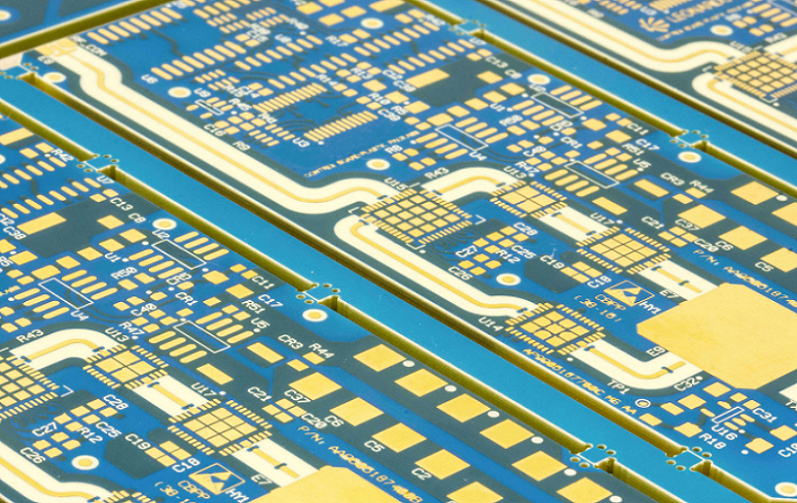
HDI PCB material selection means matching electrical loss, dielectric stability, laser drillability, thermal reliability, copper foil profile, and fabrication capability to the actual signal speed and stackup structure. For high density interconnect products, the best material is not always the lowest-loss laminate. It is the material that can meet impedance, survive sequential lamination, support 0.075 mm to 0.125 mm laser microvias, maintain stable Dk and Df, and remain manufacturable for the required HDI PCB prototype or production volume.
HDI PCB Material
HDI PCB material affects signal integrity, drilling quality, lamination yield, copper adhesion, impedance stability, and long-term reliability. A typical HDI PCB may use 3/3 mil routing, 2.5/2.5 mil local BGA escape, 0.10 mm laser microvias, 0.20 mm to 0.30 mm microvia pads, and 1-step, 2-step, or 3-step sequential lamination.
Material selection should define:
- Resin system
- Glass style
- Dielectric constant
- Dissipation factor
- Glass transition temperature
- Decomposition temperature
- Z-axis CTE
- Copper foil type
- Prepreg resin flow
- Laser drilling behavior
- CAF resistance
- Lead-free assembly compatibility
For an HDI PCB manufacturer, material selection must be confirmed before routing. If the dielectric thickness changes from 75 micrometer to 100 micrometer after layout, controlled impedance widths may need to change from 3.5 mil to 4.2 mil or more depending on Dk and copper thickness.
Low Loss PCB Material
Low Loss PCB material is used when dielectric loss and insertion loss become limiting factors. It is common in 5G equipment, mmWave modules, high-speed backplanes, AI hardware, high-speed test boards, RF front ends, radar, and SerDes channels.
Typical values:
- Standard FR-4 Df: 0.015 to 0.020
- Mid-loss material Df: 0.010 to 0.015
- Low-loss material Df: 0.004 to 0.010
- Very-low-loss material Df: 0.0015 to 0.004
- Common Dk range: 3.0 to 4.5
- High-speed impedance tolerance: plus or minus 10 percent, plus or minus 7 percent, or plus or minus 5 percent after review
The value is simple: lower Df reduces dielectric loss over distance. On short 2-inch digital routes, standard high-Tg FR-4 may work. On 10-inch to 20-inch high-speed channels above 10 Gbps, low-loss material can preserve eye opening and reduce equalization burden.
Dielectric Classifications
Dielectric Classifications help engineers avoid both under-design and over-design. Many projects fail commercially because the material is either too weak for the signal speed or too expensive for the actual requirement.
| Dielectric Class | Typical Dk | Typical Df | Suitable Use | Factory Risk |
|---|---|---|---|---|
| Normal Speed/Loss | 4.0–4.5 | 0.015–0.020 | Low-speed control, short digital routes | Low |
| Medium Speed/Loss | 3.7–4.2 | 0.010–0.015 | Industrial HDI, moderate-speed FPGA | Low to medium |
| High Speed/Low Loss | 3.2–3.9 | 0.004–0.010 | 10G–56G channels, 5G digital boards | Medium |
| Very High Speed/Very Low Loss | 3.0–3.6 | 0.0015–0.004 | RF, mmWave, 112G-class links | High |
The factory decision should consider both loss and process compatibility. A very-low-loss material may improve electrical performance but can require tighter lamination control, adjusted drilling parameters, and longer material lead time.
Normal Speed/Loss
Normal Speed/Loss materials are usually high-Tg FR-4 systems. They are suitable for low-speed HDI circuit boards, consumer electronics, industrial control boards, and short digital routes.
Typical parameters:
- Dk: 4.0 to 4.5
- Df: 0.015 to 0.020
- Tg: 150 degrees Celsius to 180 degrees Celsius
- Trace and spacing: 3/3 mil or 4/4 mil
- Laser via: 0.10 mm to 0.125 mm
- Board thickness: 0.8 mm to 2.0 mm
This class is cost-effective and stable in fabrication. It should not be used blindly for long high-speed channels above several Gbps, especially where insertion loss and phase stability are critical.
Medium Speed/Loss
Medium Speed/Loss materials are used when standard FR-4 is no longer enough, but full RF-grade laminate is not required. This is a common choice for high density interconnect products in industrial automation, embedded compute, network modules, and high-layer-count control boards.
Typical parameters:
- Dk: 3.7 to 4.2
- Df: 0.010 to 0.015
- Tg: 170 degrees Celsius to 190 degrees Celsius
- Controlled impedance: 50 ohm, 90 ohm, or 100 ohm
- HDI structure: 1+N+1 or 2+N+2
- Common microvia: 0.10 mm
The value is process balance. Medium-loss systems usually laminate and drill more predictably than PTFE-based materials while improving signal quality compared with normal FR-4.
High Speed/Low Loss
High Speed/Low Loss materials support high-speed digital interfaces where insertion loss, impedance consistency, and skew begin to dominate performance.
Typical applications:
- PCIe Gen4 and Gen5
- 10G and 25G Ethernet
- High-speed FPGA boards
- 5G base station digital sections
- AI accelerator carrier boards
- SerDes routes from 10 Gbps to 56 Gbps
Typical parameters:
- Dk: 3.2 to 3.9
- Df: 0.004 to 0.010
- Tg: 180 degrees Celsius to 200 degrees Celsius
- Copper foil: VLP or HVLP preferred
- Impedance tolerance: plus or minus 10 percent or plus or minus 7 percent
- Differential pair: 90 ohm or 100 ohm
For HDI PCB fabrication, this class often gives the best balance between electrical performance and manufacturability.
Very High Speed/Very Low Loss
Very High Speed/Very Low Loss materials are used when RF, microwave, mmWave, or 112G-class high-speed channels require extremely low insertion loss and stable dielectric properties.
Typical parameters:
- Dk: 3.0 to 3.6
- Df: 0.0015 to 0.004
- Copper: very-low-profile or hyper-low-profile copper
- Frequency concern: often above 10 GHz
- Stackup: sometimes hybrid with FR-4 or low-loss epoxy
- Fabrication risk: medium to high
This class should be selected with the HDI PCB manufacturer before layout. Very low loss does not automatically mean easy fabrication. Resin flow, copper peel strength, drilling quality, and hybrid bonding must be reviewed.
Thermal & Mechanical Properties
Thermal & Mechanical Properties decide whether the board survives lamination, assembly, and field operation. In HDI PCB material selection, electrical properties cannot be separated from mechanical stability.
Key properties include:
- Tg, normally 170 degrees Celsius or higher for lead-free HDI
- Td, commonly above 320 degrees Celsius for robust thermal stability
- Z-axis CTE, lower is better for via reliability
- X/Y CTE, important for registration
- Peel strength, important with smooth copper
- Moisture absorption, lower is better for reflow stability
- CAF resistance, important for fine spacing
- Dimensional stability after multiple press cycles
A 3-step HDI board may experience several lamination cycles before assembly reflow. Material that works on a standard multilayer board may become unstable after repeated thermal exposure.
Glass Transition Temperature (Tg)
Glass Transition Temperature (Tg) is the temperature at which the resin system changes from a rigid glassy state to a softer rubbery state. For lead-free assembly, HDI materials commonly use Tg from 170 degrees Celsius to 200 degrees Celsius.
Practical selection:
- Tg 150 degrees Celsius: general electronics
- Tg 170 degrees Celsius: common lead-free HDI
- Tg 180–200 degrees Celsius: high-reliability HDI and multiple lamination
- Peak reflow: commonly 245 degrees Celsius to 260 degrees Celsius
Higher Tg improves thermal margin, but it does not automatically mean lower loss. Tg, Dk, Df, CTE, and drillability must be reviewed together.
Coefficient of Thermal Expansion
Coefficient of Thermal Expansion, or CTE, is critical for plated holes and microvias. Z-axis expansion stresses copper barrels and microvia interfaces during thermal cycling.
Factory concerns include:
- PTH barrel cracking
- Microvia target pad separation
- Resin recession
- Inner-layer separation
- Stacked microvia interface fatigue
- Registration shift during lamination
Typical HDI reliability evaluation may use thermal cycling from minus 40 degrees Celsius to 125 degrees Celsius for 250 to 1000 cycles, depending on product class. A material with lower Z-axis CTE generally supports better interconnect reliability.
Laser Drillability
Laser Drillability is essential for high density interconnect boards. The material must form clean microvias without excessive glass residue, resin smear, carbonization, or poor copper capture.
Typical laser via values:
- Microvia diameter: 0.075 mm to 0.125 mm
- Laser dielectric thickness: 50 micrometer to 75 micrometer
- Stable aspect ratio: 0.75:1 to 1:1
- Microvia pad: 0.20 mm to 0.30 mm
- Sequential lamination registration: plus or minus 50 micrometer to 75 micrometer
Some PTFE-based or ceramic-filled materials require different laser energy, desmear chemistry, and plasma treatment compared with modified epoxy. A material may be electrically excellent but unsuitable for small microvia HDI PCB prototype builds if drilling quality is unstable.
Why Low Loss Matters
Low loss matters because signal energy is lost as heat in the dielectric and conductor. At low speed, the effect may be small. At high frequency, the same route length can create eye closure, jitter, timing margin loss, and higher bit error rate.
Low-loss material provides:
- Lower insertion loss
- Better eye opening
- More stable phase delay
- Reduced equalization demand
- Improved impedance consistency
- Longer usable routing distance
For a 100 ohm differential SerDes channel, the material decision can determine whether the product passes compliance testing without redesign.
Reduced Dielectric Loss
Reduced Dielectric Loss is mainly controlled by Df. Lower Df means less energy is absorbed by the resin system.
Practical comparison:
| Material Choice | Typical Df | Best Use | Result |
|---|---|---|---|
| Standard FR-4 | 0.015–0.020 | Short low-speed routes | Lowest cost |
| Low-loss epoxy | 0.004–0.010 | High-speed digital HDI | Better eye margin |
| PTFE-based laminate | 0.0015–0.004 | RF and microwave | Lowest dielectric loss |
For website buyers and engineers, the selection should be tied to actual signal speed and length. A short 5 Gbps route may not need PTFE. A long 25 Gbps route may need low-loss material and smooth copper.
Preserved Signal Integrity
Preserved Signal Integrity means maintaining waveform quality from transmitter to receiver. Material selection affects insertion loss, impedance, skew, and crosstalk.
Material-related SI risks include:
- Dk variation across frequency
- Glass weave skew
- Copper roughness loss
- Dielectric thickness tolerance
- Resin-rich and glass-rich imbalance
- Hybrid stackup mismatch
For HDI circuit boards with 100 ohm differential pairs, common impedance targets are plus or minus 10 percent for standard work and plus or minus 7 percent for tighter high-speed designs. Plus or minus 5 percent should be used only after material and process review.
Impedance Consistency
Impedance Consistency depends on Dk, dielectric thickness, copper thickness, trace width, and etching stability. HDI layers are thin, so small changes matter.
Factory values:
- Trace width tolerance: often plus or minus 0.5 mil for fine lines
- Dielectric tolerance after pressing: commonly around plus or minus 10 percent
- Outer copper after plating: often 35 micrometer to 50 micrometer
- Controlled impedance: 50 ohm, 90 ohm, or 100 ohm
- TDR coupon testing required for controlled impedance
A stable material with predictable press thickness can be better than an exotic laminate with long lead time and unstable resin flow.
Material Types
Material Types should be selected by electrical need and fabrication risk.
Main categories:
- PTFE (Teflon)-based
- Hydrocarbon-Ceramic
- Advanced Low-Loss Epoxies / Modified Resins
- High-Tg FR-4
- Hybrid constructions
Each type has tradeoffs. PTFE offers excellent RF performance but may be harder to process. Modified epoxy is easier for HDI PCB fabrication and often suitable for high-speed digital boards.
PTFE (Teflon)-based
PTFE-based materials provide very low dielectric loss and stable high-frequency performance.
Typical use:
- RF
- Microwave
- mmWave
- Radar
- Antenna boards
- High-frequency test boards
Typical considerations:
- Dk often around 2.2 to 3.5 depending on filler
- Df can be below 0.004
- Special surface preparation may be required
- Drilling and plating process must be controlled
- Hybrid lamination needs engineering review
PTFE is not always the best choice for dense HDI. It should be selected when RF loss and frequency stability justify the process complexity.
Hydrocarbon-Ceramic
Hydrocarbon-Ceramic materials offer low loss with improved dimensional and thermal behavior compared with pure PTFE systems in many applications.
Typical use:
- 5G RF modules
- Automotive radar
- Antenna arrays
- High-frequency mixed-signal boards
Production considerations:
- Ceramic filler can affect drilling behavior
- Resin flow must be checked in hybrid stackups
- Copper adhesion should be validated
- Lamination parameters may differ from FR-4
- Laser microvia processing requires supplier confirmation
This category is useful when RF performance is needed but the board still requires practical multilayer fabrication.
Advanced Low-Loss Epoxies
Advanced Low-Loss Epoxies / Modified Resins are often the most practical choice for high-speed HDI PCB fabrication. They provide lower Df than standard FR-4 while keeping a fabrication process closer to conventional multilayer PCB production.
Typical use:
- 10G to 56G digital boards
- AI computing modules
- Network switches
- 5G base station digital cards
- High-layer-count HDI circuit boards
Typical values:
- Dk: 3.2 to 3.9
- Df: 0.004 to 0.010
- Tg: 180 degrees Celsius to 200 degrees Celsius
- Compatible with 3/3 mil and 2.5/2.5 mil routing after review
- Suitable for 1+N+1 and 2+N+2 HDI structures
For many customers, this is the best balance between performance, yield, cost, and lead time.
Industry-Standard Material Brands
Industry-Standard Material Brands matter because design teams and factories often qualify materials by brand family, data sheet, availability, and previous production history.
Commonly used high-performance laminate suppliers include:
- Rogers Corporation
- Panasonic
- Isola
Other material suppliers may also be suitable when electrical data, IPC-4101 slash sheet reference, factory experience, and customer approval are available.
Rogers Corporation
Rogers Corporation materials are commonly used in RF, microwave, antenna, radar, and high-frequency applications. They are often selected when low Df, stable Dk, and frequency performance are more important than low cost.
Factory review points:
- Hybrid bonding to FR-4
- Plasma treatment
- Drilling method
- Copper type
- Lamination cycle
- Surface preparation
- Material lead time
For HDI PCB material selection, Rogers-type materials are strong candidates for RF layers, but full HDI stackup compatibility must be checked.
Panasonic
Panasonic high-speed materials are often used in advanced digital boards, network equipment, automotive electronics, and high-reliability multilayer builds.
Factory review points:
- High-Tg performance
- Low-loss digital routing
- Lead-free reflow stability
- Sequential lamination behavior
- Availability of core and prepreg combinations
- Compatibility with fine-line etching
Panasonic-type low-loss systems are common where high-speed digital performance and manufacturability must be balanced.
Isola
Isola materials are widely used for high-speed digital, RF/microwave, and high-reliability PCB applications. Product families may cover mid-loss, low-loss, and very-low-loss requirements.
Factory review points:
- Dk and Df stability
- Tg and Td
- CAF resistance
- Copper foil options
- Prepreg flow
- Impedance control consistency
- Availability for prototype and production
For HDI PCB prototype work, material availability can be as important as electrical performance. A material that is technically ideal but unavailable for 3 weeks may not fit an urgent build.
Manufacturing & Design Considerations
Manufacturing & Design Considerations connect material selection to real production yield.
Key items:
- Minimum trace and spacing: 3/3 mil standard, 2.5/2.5 mil advanced, 2/2 mil special review
- Laser via: 0.075 mm to 0.125 mm
- Microvia aspect ratio: 0.75:1 to 1:1
- Controlled impedance tolerance: plus or minus 10 percent or plus or minus 7 percent
- Sequential lamination: 1-step, 2-step, or 3-step
- Copper foil profile: RTF, VLP, or HVLP
- Surface finish: ENIG, immersion silver, OSP, or other specified finish
- Test: TDR, microsection, AOI, X-ray when required
The HDI PCB manufacturer should review material, stackup, drill structure, and impedance before layout release.
Copper Foil Profile
Copper Foil Profile affects conductor loss and copper adhesion. At high frequencies, current flows near the copper surface, so rough copper increases loss.
Common copper options:
- Standard electrodeposited copper
- Reverse-treated foil
- Very-low-profile copper
- Hyper-low-profile copper
| Copper Profile | Loss Impact | Adhesion | Best Use |
|---|---|---|---|
| Standard ED | Higher loss | Strong | Low-speed or cost-driven boards |
| VLP | Lower loss | Medium | High-speed digital HDI |
| HVLP | Lowest conductor loss | Requires review | 56G, 112G, RF-sensitive channels |
Smooth copper improves signal loss but may reduce peel strength. The factory must verify lamination and copper bonding reliability.
Hybrid Construction
Hybrid Construction combines different materials in one stackup, such as RF laminate on outer layers and low-loss epoxy or FR-4 in the core.
Benefits:
- Lower cost than full RF laminate
- RF performance where needed
- Better mechanical balance
- More flexible stackup design
Risks:
- Different CTE values
- Resin flow mismatch
- Registration shift
- Lamination voids
- Impedance transition mismatch
- Different drilling behavior
Hybrid boards should be reviewed with cross-section samples, test coupons, and controlled lamination parameters before production release.
PCB Material Selection
PCB Material Selection should follow a practical decision flow:
- Define signal speed and route length.
- Define impedance targets such as 50 ohm or 100 ohm differential.
- Select dielectric class by Df and Dk.
- Confirm Tg, Td, CTE, and reflow requirements.
- Check laser drillability for 0.075 mm to 0.125 mm microvias.
- Confirm stackup thickness and material availability.
- Select copper foil profile based on loss budget.
- Review hybrid construction risk if mixed materials are used.
- Ask the HDI PCB manufacturer to simulate impedance and confirm process capability.
- Validate with TDR coupons, microsection, and first article inspection.
A good material decision reduces redesign, controls cost, and improves yield.
Quality Control Requirements
Quality control must prove that the selected material performs in production, not only on a data sheet.
Factory quality control should include:
- Incoming laminate certificate check
- Material lot traceability
- Prepreg storage condition control
- Lamination press cycle record
- Dielectric thickness measurement
- Copper thickness measurement
- Inner-layer AOI
- Laser microvia inspection
- Microsection for via plating and dielectric verification
- TDR impedance coupon report
- Thermal stress or thermal cycling when required
- Final electrical test
- Certificate of conformance when required
Typical inspection values:
- Microsection magnification: 50X to 200X
- Impedance coupon tolerance: plus or minus 10 percent or tighter if specified
- Laser via diameter check: 0.075 mm to 0.125 mm
- Fine-line AOI: 2.5/2.5 mil or 3/3 mil
- Thermal cycling: minus 40 degrees Celsius to 125 degrees Celsius for selected high-reliability builds
Real Factory Case
A 16-layer 2+N+2 HDI PCB prototype was designed for a 25G optical communication module. The original stackup used standard high-Tg FR-4, 3/3 mil routing, 0.10 mm laser microvias, 0.25 mm microvia pads, 100 ohm differential pairs, and 1.6 mm finished board thickness.
Original condition:
- Material Dk: about 4.2
- Material Df: about 0.018
- Differential trace width: 3.5 mil
- Differential spacing: 5.0 mil
- Impedance target: 100 ohm plus or minus 10 percent
- High-speed route length: about 180 mm
- Surface finish: ENIG
Problem during validation:
- Eye diagram margin was low at the receiver
- TDR showed local impedance variation near hybrid BGA breakout
- Insertion loss was higher than expected
- Long routes on inner stripline layers were sensitive to glass weave skew
Corrective action:
- Changed high-speed layers to low-loss modified resin material
- Df reduced from about 0.018 to about 0.006
- Changed copper to VLP foil on critical signal layers
- Adjusted dielectric thickness from 75 micrometer to 90 micrometer
- Differential pair changed to 3.8 mil width and 5.5 mil spacing
- Added glass weave alignment review for long differential pairs
- Rebuilt impedance coupons for L3, L6, L11, and L14
Result:
- 100 ohm differential coupons measured from 96.5 ohm to 103.8 ohm
- Insertion loss improved enough to pass system validation
- Microsection confirmed stable 0.10 mm microvia plating
- AOI found no over-etched fine-line defects
- The customer approved the low-loss material for production
This case shows why HDI PCB material selection must consider loss, impedance, copper foil, glass weave, and production capability together.
Common Design Errors
- Selecting material only by Dk
Df, Tg, CTE, copper foil, and drillability are equally important. - Using PTFE where modified epoxy is enough
This increases cost and process risk without measurable system benefit. - Ignoring copper roughness
Smooth copper can reduce conductor loss in high-speed channels. - Changing material after routing
New Dk and dielectric thickness can invalidate impedance geometry. - Using very thin dielectric without review
A 50 micrometer dielectric layer is useful but sensitive to press variation. - Not checking laser drillability
Some materials do not form clean 0.075 mm microvias without process changes. - Overlooking hybrid construction risk
Mixed materials may create lamination and CTE mismatch issues. - Missing material traceability
Without lot traceability, field failure analysis becomes slow and uncertain.
FAQ
Question: What is the best material for HDI PCB?
Answer: The best HDI PCB material depends on signal speed, route length, impedance target, stackup, microvia size, thermal requirement, and cost. Standard high-Tg FR-4 works for many low-speed designs, while low-loss modified resin or RF-grade material is better for high-speed, RF, 5G, and long SerDes routes.
Question: When should low loss PCB material be used?
Answer: Low loss PCB material should be used when dielectric loss affects signal integrity, usually on long high-speed routes, RF paths, 10G to 56G digital channels, or mmWave applications. A typical low-loss Df range is 0.004 to 0.010, while very-low-loss material may be below 0.004.
Question: Why does Tg matter in HDI PCB fabrication?
Answer: Tg matters because HDI boards often go through multiple lamination cycles and lead-free reflow at 245 degrees Celsius to 260 degrees Celsius. A Tg of 170 degrees Celsius to 200 degrees Celsius provides better thermal margin for sequential lamination and assembly.
Question: How should an HDI PCB manufacturer verify material quality?
Answer: An HDI PCB manufacturer should verify material quality through incoming certificate review, material lot traceability, dielectric thickness measurement, copper thickness inspection, laser microvia checks, microsection analysis, TDR impedance coupon testing, AOI, final electrical test, and thermal reliability testing when required.

![Understanding PCB Costs & Pricing [Your Complete Guide]](https://hdicircuitboard.com/wp-content/uploads/elementor/thumbs/Understanding-PCB-Costs-Pricing-Your-Complete-Guide-qzzhe6mcaxuolkux3xalfktgavumi9y1aqfbs9bpv4.webp "Understanding PCB Costs & Pricing [Your Complete Guide]")