







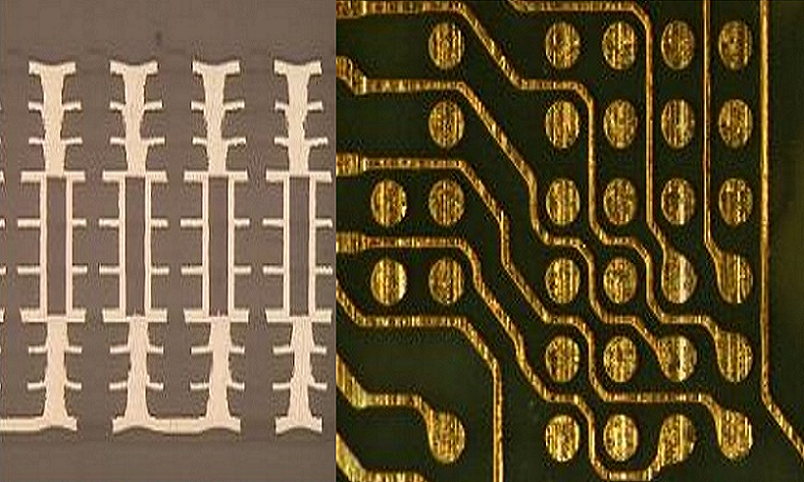
HDI PCB for fine-pitch BGA is required when BGA ball pitch, package size, escape routing density, and assembly yield exceed the practical limits of standard through-via PCB routing. In most engineering projects, 0.8 mm BGA can often be routed with conventional fanout, 0.65 mm may need selective high density interconnect methods, while 0.5 mm and 0.4 mm BGA usually require microvias, via-in-pad, VIPPO, sub-3-mil geometries, and Type I, Type II, Type III, or ELIC stackups. The goal is not only to connect the BGA pins. The goal is to maintain routing density, solder joint quality, impedance control, power delivery, and manufacturable hdi pcb fabrication from prototype to production.
Fine-Pitch BGA Decision Point
Ball Pitch Size
Fine-Pitch BGA is normally defined by small ball-to-ball spacing. In PCB layout work, the practical problem begins when pad size, solder mask clearance, via land, trace width, and spacing can no longer coexist inside the BGA grid.
Common ball pitch ranges:
| BGA Ball Pitch | Practical Routing Condition | Typical PCB Type |
|---|---|---|
| 1.00 mm | Dogbone fanout usually has enough space | Standard multilayer PCB |
| 0.80 mm | Dogbone routing often works with careful via and trace rules | Standard or entry HDI PCB |
| 0.65 mm | Escape routing starts to need microvias or fine lines | Type I HDI PCB |
| 0.50 mm | Routing between via fields becomes difficult | Type I or Type II HDI PCB |
| 0.40 mm | Via-in-pad and microvia fanout are usually required | Type II, Type III, or ELIC |
| Below 0.40 mm | Conventional HDI may not provide enough routing freedom | ELIC or Ultra HDI |
AMD’s BGA design guidance states that as pitch decreases, routing becomes more difficult because there is less room for traces and vias between balls. Its 0.5 mm examples show why via-in-pad becomes important when routing space disappears inside the BGA matrix.
Package Size and Ball Count
A small-pitch BGA is not always difficult by itself. A 0.5 mm BGA with 64 balls can be easier than a 0.65 mm BGA with hundreds of balls and multiple inner rows. Package size and ball count determine how many escape layers are needed.
Engineering review should check:
- Ball pitch: 0.8 mm, 0.65 mm, 0.5 mm, 0.4 mm, or below
- Ball count and number of inner rows
- Power and ground ball distribution
- Differential pair locations
- High-speed interface location
- Decoupling capacitor access
- Test access and boundary scan
- BGA keepout and component spacing
- Assembly inspection requirement
The first production question should be: can the inner rows escape with a cost-safe structure, or does the design require VIPPO, stacked microvias, or ELIC?
Manufacturing and Design Challenges
Fanout Limits
Fine-pitch BGA fanout is where many hdi pcb prototype failures begin. Designers sometimes complete outer-row routing successfully, then discover that the inner signal rows, power pins, and test access cannot escape without changing the stackup.
Fanout options:
| Fanout Method | Best Pitch Range | Process Cost | Main Risk |
|---|---|---|---|
| Dogbone via fanout | 1.0 mm to 0.8 mm | Low | Consumes routing area |
| Microvia escape | 0.65 mm to 0.5 mm | Medium | Requires laser drilling control |
| Via-in-pad | 0.5 mm and below | High | Requires fill and cap quality |
| Staggered microvias | 0.5 mm to 0.4 mm | Medium to high | Needs accurate layer planning |
| Stacked microvias | 0.5 mm to 0.4 mm | High | Needs copper-fill reliability |
| ELIC | 0.4 mm and below | Very high | Requires every-layer process control |
For engineering teams, the mistake is choosing the fanout method only from CAD clearance. Fanout must match the hdi pcb manufacturer’s laser drill, copper fill, solder mask, plating, and inspection capability.
Assembly Risks
Fine-pitch BGA assembly has hidden solder joints. AOI cannot directly inspect solder collapse under the package. X-ray inspection is commonly used to evaluate hidden BGA solder joints, voids, bridges, and alignment issues.
Major assembly risks include:
- Head-in-pillow defects
- Solder bridging between adjacent balls
- VIPPO solder wicking
- Excessive solder voids
- BGA corner opens from warpage
- Uneven solder volume from via dimple
- Flux residue under dense packages
- Package tilt after reflow
- Intermittent failure after thermal cycling
Fine-pitch BGA should be reviewed as a PCB and PCA problem. PCB means the bare board. PCA means the assembled circuit board with components, solder joints, firmware, labels, inspection data, and functional test records.
HDI PCB Routing Window
Trace and Space
Sub-3-mil geometry means trace and space below about 75 microns. Fine-pitch BGA designs often need 75/75 microns or 50/50 microns in the BGA escape region. However, fine geometry should be used locally, not across the whole board, unless the full routing density requires it.
| Routing Class | Trace / Space | Typical Use |
|---|---|---|
| Conventional multilayer | 100/100 microns | 0.8 mm and larger BGA |
| Standard HDI | 75/75 microns | 0.65 mm and some 0.5 mm BGA |
| Advanced HDI | 50/50 microns | Dense 0.5 mm and 0.4 mm BGA |
| Ultra HDI | Below 30/30 microns | Ultra-fine pitch and chiplet-style fanout |
Fine traces depend on copper thickness. A 50/50 micron pattern is easier to hold on 9-18 micron copper than on 35 micron copper. Thick copper improves current handling but reduces etching margin in dense BGA fields.
Pad, Via, and Mask Rules
Fine-pitch BGA layout must balance pad diameter, solder mask opening, via land, trace clearance, and plane clearance.
Key values to define before routing:
- BGA land diameter
- Solder mask defined or non-solder mask defined pad style
- Solder mask expansion
- Microvia diameter
- Capture pad diameter
- Via-in-pad fill and cap requirement
- Inner-layer clearance
- Trace width through BGA escape
- Anti-pad clearance
- Test coupon geometry
For 0.5 mm and 0.4 mm BGA, a 25 micron change in solder mask or trace clearance can decide whether the design is manufacturable.
Critical HDI Techniques
Via-in-Pad
Via-in-pad places the via directly in the BGA pad. VIPPO fills the via, plates over it, and creates a flat solderable pad. This method is often required when dogbone fanout cannot fit between BGA balls.
| VIPPO Control | Practical Target | Why It Matters |
|---|---|---|
| Via diameter | 75-125 microns | Supports reliable fill |
| Dimple after planarization | Below 10-15 microns | Prevents uneven solder volume |
| Copper cap | Continuous plated cap | Prevents solder wicking |
| Surface finish | ENIG or equivalent | Supports fine-pitch solderability |
| Inspection | X-ray and microsection | Finds hidden void or fill defects |
Via-in-pad increases cost because it adds filling, planarization, plating, and inspection. It should be used where fanout density or electrical performance requires it.
Microvias
Microvias reduce routing blockage because they connect only adjacent HDI layers instead of passing through the full board. IPC-2226 covers design considerations for HDI printed boards and microvia technology, while IPC-2221 provides the general design framework for printed boards.
Practical microvia rules:
- Standard microvia diameter: 75-125 microns
- Advanced microvia diameter: 50-75 microns
- Buildup dielectric: 50-80 microns
- Aspect ratio: keep at or below 1:1
- Capture pad: often 200-300 microns
- Inspection: AOI, E-test, microsection, and X-ray sampling
A microvia should not be treated like a small mechanical via. Its reliability depends on dielectric thickness, laser quality, copper plating, and thermal cycling.
Stacked and Staggered Vias
| Item | Staggered Microvias | Stacked Microvias |
|---|---|---|
| Density | Medium to high | Highest |
| Cost | Lower | Higher |
| Copper filling | Less demanding | Required |
| Reliability margin | Better in many builds | Depends on fill quality |
| Best use | Production-friendly fanout | Extreme inner-row BGA escape |
A staggered structure should be used when routing space allows. Stacked microvias are useful when vertical density is the limiting factor, but they increase fabrication risk.
HDI Stackup Options
Type I, Type II, Type III
HDI stackup should be selected by package pitch, inner-row count, signal speed, and power distribution.
| HDI Stackup | Common Structure | Best Fit | Production Risk |
|---|---|---|---|
| Type I | 1+N+1 | 0.65 mm BGA and moderate 0.5 mm BGA | Lower |
| Type II | 2+N+2 | Dense 0.5 mm BGA | Medium |
| Type III | 3+N+3 | 0.4 mm BGA and dense processors | High |
| ELIC | Every Layer Interconnect | Extreme BGA density | Very high |
Type I provides a cost-controlled entry point. Type II adds more escape routing. Type III and ELIC should be selected only when the BGA ball map cannot be escaped with lower stackup cost.
ELIC for Ultra-Dense BGA
ELIC means Every Layer Interconnect. It gives every layer more routing access through copper-filled microvias. This is valuable for ultra-dense fine-pitch BGA, but it adds lamination, filling, registration, and inspection demand.
ELIC benefits:
- More escape paths from inner BGA rows
- Shorter vertical interconnects
- Higher routing density
- Better freedom for signal and power layer assignment
- Potential layer-count reduction in extreme designs
ELIC risks:
- More sequential lamination cycles
- Higher microvia fill demand
- Higher registration risk
- Higher cost
- Narrower supplier base
- More microsection and X-ray inspection
Benchuang Fine-Pitch Capability
HDI PCB fine-pitchCapability
Benchuang fine-pitch capability shows annular ring at 0.065 mm, micro via hole at 0.075 mm, via land at 0.205 mm, plane clearance at 0.325 mm, solder mask values around 0.255-0.275 mm, and track examples including 0.05 mm. These values are directly relevant to fine-pitch BGA escape review because they define the routing, via land, annular ring, plane clearance, and mask-space window around dense BGA pads.
| Benchuang Capability Item | Value | Engineering Use |
|---|---|---|
| Annular ring | 0.065 mm | Via registration margin |
| Micro via hole | 0.075 mm | Fine via planning reference |
| Via land | 0.205 mm | BGA escape capture pad reference |
| Plane clearance | 0.325 mm | Inner copper clearance review |
| Solder mask | 0.255-0.275 mm | Fine-pitch solder mask planning |
| Track example | 0.05 mm | Fine-line routing reference |
These numbers should be treated as a project review baseline, not a universal guarantee. Final capability depends on copper thickness, stackup, finish, solder mask, layer count, panel size, impedance target, and production quantity.
Fine-Pitch Review Checklist
For a fine-pitch BGA project, Benchuang Electronics’ HDI PCB fine pitch capability should be reviewed through:
- BGA pitch and ball count
- Pad diameter and solder mask style
- Track and spacing in escape region
- Microvia drill and land size
- Annular ring requirement
- Plane clearance requirement
- VIPPO fill and dimple target
- Solder mask bridge width
- ENIG planarity
- X-ray and microsection plan
- Impedance coupon design
- hdi pcb prototype to pilot yield target
A capable hdi pcb manufacturer should confirm the process window before layout release, not after CAM finds conflicts.
Next Manufacturing Steps
Consult Fabricator Limits
Engineers should send the hdi pcb manufacturer a design-intent package before final routing.
The package should include:
- BGA datasheet and ball map
- Target pitch and package size
- Board outline and thickness
- Stackup target
- Microvia and via-in-pad plan
- Trace and spacing target
- Controlled impedance table
- Copper thickness
- Surface finish
- Assembly inspection requirement
- IPC class requirement
- Expected prototype and production quantity
IPC-6012 covers performance and qualification requirements for rigid printed boards, including multilayer structures with blind or buried vias, and should be aligned with the project acceptance class.
Software Setup
CAD rules must reflect the real manufacturing window.
Required software rules:
- Fine-pitch BGA pad diameter
- Solder mask expansion
- Paste mask rule
- Microvia drill and capture pad
- Via-in-pad layer rule
- Stacked and staggered via rule
- Trace width by BGA region
- Differential impedance rules
- Plane clearance rules
- Test pad keepouts
- Assembly courtyard clearance
- DFM checks for mask slivers and copper spacing
When CAD rules are looser than the factory process, the project gets CAM engineering questions. When CAD rules are tighter than needed, cost rises without better yield.
Two Key Comparisons
0.5 mm BGA vs 0.4 mm BGA
| Item | 0.5 mm BGA | 0.4 mm BGA |
|---|---|---|
| Routing difficulty | High | Very high |
| Common fanout | Microvia or via-in-pad | VIPPO and microvia fanout |
| Typical stackup | Type I or Type II | Type II, Type III, or ELIC |
| Trace / space | 75/75 or 50/50 microns | 50/50 microns or finer |
| Assembly risk | Medium to high | High |
| Inspection | X-ray recommended | X-ray strongly required |
Dogbone Fanout vs Via-in-Pad
| Item | Dogbone Fanout | Via-in-Pad |
|---|---|---|
| Best pitch | 1.0 mm to 0.8 mm | 0.5 mm and below |
| Cost | Lower | Higher |
| Routing density | Moderate | High |
| Signal path | Longer | Shorter |
| Solder risk | Lower if spacing allows | Needs fill and cap control |
| Best use | Standard BGA packages | Fine-pitch BGA packages |
Quality Control Plan
Bare Board Inspection
Fine-pitch BGA hdi pcb fabrication should include:
- CAM and DFM review
- Stackup verification
- Material certificate check
- Laser drill inspection
- AOI for fine-line defects
- 100% E-test for opens and shorts
- Microsection for microvia plating
- X-ray for stacked microvia and VIPPO areas
- VIPPO dimple measurement
- Impedance coupon testing
- Warpage measurement after thermal simulation
- Final visual inspection under fine-pitch criteria
Assembly Inspection
Fine-pitch BGA assembly should include:
- Solder paste inspection
- Reflow profile validation
- X-ray inspection for hidden joints
- BGA void review
- Bridging check
- Head-in-pillow review
- Thermal soak test
- Functional test under load
- Cross-section if repeated defects appear
The quality target is not only passing the first board. The target is repeatable yield across hdi pcb prototype, EVT, DVT, PVT, and production.
Real Factory Case
Project Profile
A customer used a 0.4 mm pitch BGA processor in a compact industrial vision module. The original layout attempted partial dogbone routing and local microvias, but CAM review showed that inner-row escape and solder mask clearance were not stable enough for pilot production.
| Item | Project Data |
|---|---|
| Product type | Industrial vision module |
| BGA pitch | 0.4 mm |
| Package area | 18 mm x 18 mm |
| Layer count | 10 layers |
| HDI structure | 2+6+2 |
| Board thickness | 1.0 mm |
| BGA escape trace / space | 50/50 microns |
| Microvia | 75 microns laser via |
| Via type | VIPPO plus staggered microvias |
| Finish | ENIG |
| Controlled impedance | 90 ohm USB, 100 ohm MIPI, 50 ohm clock |
| Inspection | AOI, E-test, X-ray, microsection, impedance coupon |
Production Issue
The first prototype lot had 60 boards. Bare-board testing passed, but assembly validation found:
- 4 boards with BGA solder void concentration near one corner
- 3 boards with intermittent MIPI image dropout
- 2 boards with USB enumeration failure after thermal soak
- VIPPO dimple variation from 8 microns to 18 microns
- Solder mask sliver too narrow between two BGA pad rows
Root causes:
- Two high-speed escape routes crossed a reference transition without enough ground stitching.
- VIPPO dimple control was too loose for the 0.4 mm BGA package.
- The solder mask rule was copied from a larger-pitch BGA project.
- One stacked microvia pair was used where a staggered structure could fit.
- Decoupling placement left two critical power pins more than 5 mm from the nearest 0.1 uF capacitor.
Corrective Actions
The revised pilot changed:
- VIPPO dimple target to below 10 microns
- Solder mask clearance increased by 25 microns in the BGA field
- Two stacked microvia columns changed to staggered microvias
- Ground stitching added near high-speed transitions
- Two 0.1 uF capacitors moved within 2 mm of the BGA power pins
- X-ray sampling increased to every panel
- Microsection coupons added near the BGA fanout region
| Metric | Prototype Lot | Revised Pilot |
|---|---|---|
| BGA void-related rejects | 4/60 | 0/150 |
| MIPI dropout | 3/60 | 0/150 |
| USB thermal-soak failure | 2/60 | 0/150 |
| VIPPO dimple range | 8-18 microns | Below 10 microns |
| First-pass assembly yield | 85.0% | 97.3% |
This result came from changing the process window, not simply rerouting the board. Fine-pitch BGA success depends on pad geometry, via design, solder mask, stackup, impedance, assembly, and inspection working together.
Common Design Errors
BGA Fanout Errors
- Choosing dogbone fanout for 0.5 mm or 0.4 mm BGA without density review
- Starting placement before confirming the fanout strategy
- Treating all BGA rows as equal routing difficulty
- Using via-in-pad without fill and cap requirements
- Ignoring solder mask registration between pad rows
- Leaving no test strategy for hidden BGA connections
HDI Fabrication Errors
- Using stacked microvias where staggered microvias fit
- Exceeding microvia aspect ratio limits
- Using 35 micron copper in 50/50 micron escape regions
- Missing microsection coupons
- Missing VIPPO dimple criteria
- Changing material after hdi pcb prototype approval
- Ignoring panel-level yield for dense BGA fanout
Assembly Errors
- Skipping X-ray on fine-pitch BGA
- Using an unverified reflow profile
- Ignoring warpage after reflow
- Not checking head-in-pillow risk
- Not measuring hidden solder voids
- Treating PCB pass as PCA pass
- Not testing high-speed links after thermal soak
FAQ About HDI PCB for Fine-Pitch BGA
Question: What BGA pitch usually requires HDI PCB?
Answer: HDI PCB is commonly required at 0.5 mm and 0.4 mm BGA pitch, especially when the package has many inner rows. A 0.65 mm BGA may use selective HDI, while 0.8 mm and 1.0 mm BGA can often use standard fanout when board area is available.
Question: Is via-in-pad required for 0.5 mm BGA?
Answer: Via-in-pad is often required for 0.5 mm BGA when dogbone fanout cannot provide enough routing space. Some simple 0.5 mm packages can use microvia-assisted routing, but dense packages usually need VIPPO, controlled dimple, X-ray inspection, and microsection validation.
Question: How should engineers choose HDI stackup for fine-pitch BGA?
Answer: Engineers should choose HDI PCB stackup by BGA pitch, package size, ball count, routing density, signal speed, power requirements, and production yield. Type I can fit some 0.65 mm and 0.5 mm designs. Type II is common for dense 0.5 mm BGA. Type III or ELIC may be needed for 0.4 mm and smaller packages.

![Understanding PCB Costs & Pricing [Your Complete Guide]](https://hdicircuitboard.com/wp-content/uploads/elementor/thumbs/Understanding-PCB-Costs-Pricing-Your-Complete-Guide-qzzhe6mcaxuolkux3xalfktgavumi9y1aqfbs9bpv4.webp "Understanding PCB Costs & Pricing [Your Complete Guide]")