







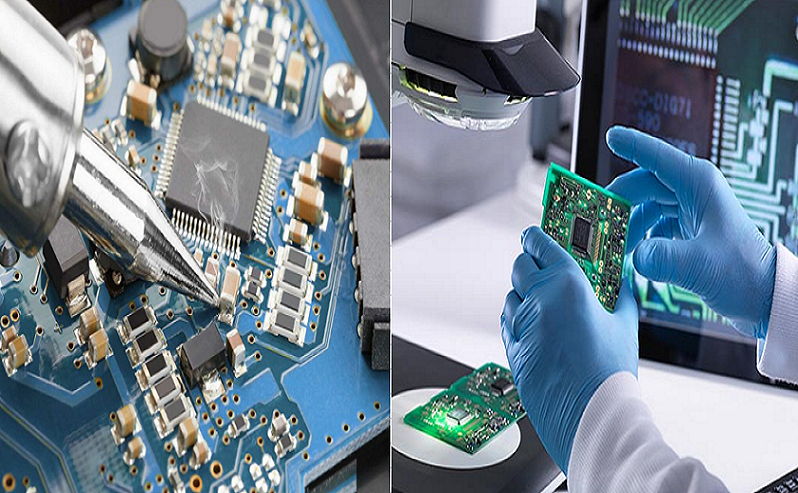
How to Solder PCB Like a Pro: Step-by-Step Guide for All Circuit Board Types
Essential PCB Soldering Materials and Tools
Core Soldering Equipment
- Soldering Iron: Pencil-shaped handheld tool with interchangeable tips (chisel, conical, bevel) made of copper core with iron plating; temperature control (325-375°C for most applications) is critical for preventing circuit board damage.
- Solder: Choose between leaded (60/40 Sn/Pb or 63/37 Sn/Pb, melting point 180-190°C) and lead-free (Sn-Cu or Sn-Ag-Cu, melting point 217-227°C) variants compliant with RoHS standards.
- Flux: Rosin flux (non-corrosive, no cleanup required), organic acid flux (aggressive oxide removal, water-soluble), or alcohol-based no-clean flux (fast-evaporating, low splatter).
- Soldering Paste: Putty-like mixture of solder particles and flux for temporary component adhesion on flexible printed circuit and hdi circuit boards.
- Desoldering Tools: Solder wick (braided copper wire for removing excess solder) and solder vacuum (solder sucker for through-hole component removal).
Supporting Tools
- Iron Stand: Heat-resistant holder with brass sponge (for tip cleaning without temperature shock) or wet sponge.
- Circuit Board Holders: Third hand (articulated arms with alligator clips), PCB vise, or magnetic holders for stable positioning of rigid flex pcb and multilayer pcb.
- Cutting Tools: Diagonal cutters and flush cutters for trimming component leads post-soldering.
- Cleaning Supplies: Compressed air, isopropyl alcohol (IPA), lint-free wipes, and industrial cleaning pads (3M Scotch Brite) for surface preparation.
- Safety Gear: Safety glasses, heat-resistant mat, and well-ventilated workspace to avoid fume inhalation and burns.
Material Selection by PCB Type
| PCB Type | Recommended Solder | Flux Type | Special Considerations |
|---|---|---|---|
| Flexible PCB/Flexible Printed Circuit | Lead-free Sn-Ag-Cu | No-clean flux | Use low-temperature settings to avoid substrate damage |
| HDI PCB/HDI Circuit Boards | Fine-gauge lead-free | Rosin flux | Precision tips for microvia and blind via soldering |
| RF PCB | Lead-free Sn-Cu | Alcohol-based flux | Minimize solder residue for signal integrity |
| Multilayer PCB | 63/37 Sn/Pb (or lead-free equivalent) | Organic acid flux | Ensure through-hole penetration for layer connections |
| Rigid Flex PCB | Low-temperature lead-free | No-clean flux | Balance heat distribution across rigid and flexible sections |
Pre-Soldering Preparation
Circuit Board Surface Preparation
- Clean the circuit board surface with industrial cleaning pads to remove tarnish and oxidation from copper pads; avoid kitchen-grade pads with soap residues.
- For stubborn deposits, use fine steel wool (cautiously on tight-tolerance boards to prevent steel shavings in holes).
- Wipe the board with acetone or methyl hydrate to remove cleaning pad debris and chemical contaminants; test on silk-screened areas first to avoid ink damage.
- Blow compressed air through holes to remove dust and dry the board thoroughly.
- Clean component leads with a dry cloth to remove tarnish or glue buildup.
Soldering Iron Preparation (Tinning)
- Heat the soldering iron to the recommended temperature (325-375°C for standard PCBs, lower for flexible printed circuit).
- Once fully heated, coat the entire tip with molten solder—ensure complete coverage to improve heat transfer and prevent oxidation.
- Immediately wipe the tinned tip on a brass sponge or wet sponge to remove excess flux residue.
- Reapply a thin layer of solder to the cleaned tip; repeat this process whenever the tip is replaced or cleaned.
Workspace Setup
- Lay a heat-resistant mat or cardboard to catch solder drips and protect the workspace.
- Position the soldering iron stand in a low-traffic area to avoid accidental contact.
- Organize components by size (smallest to largest) for efficient assembly.
- Ensure adequate lighting and ventilation to minimize eye strain and fume exposure.
Step-by-Step PCB Soldering Process
Component Placement
- Start with small, flat components (resistors, diodes, ICs) before moving to larger parts (capacitors, transformers) to maintain circuit board flatness.
- Insert component leads through the appropriate holes; bend leads at a 45-degree angle on the bottom of the board to secure small components.
- Use masking tape to hold short-lead components (IC sockets) in place on rigid flex pcb or flexible pcb.
- Save static-sensitive components (MOSFETs, CMOS ICs) for last to reduce damage risk during assembly.
- For hdi circuit boards with microvia or blind via, ensure components align with high density interconnect paths.
Applying Heat
- Apply a small amount of solder to the iron tip to enhance heat conduction.
- Position the tip to contact both the component lead and the circuit board pad simultaneously—heating only one surface results in poor adhesion.
- Hold the iron in place for 1-2 seconds (longer for large components or thick pads on multilayer pcb).
- Stop heating immediately if the area under the pad bubbles to prevent pad lifting; allow cooling before reheating briefly.
Applying Solder
- Touch the solder strand to the component lead and pad (not the iron tip) once the joint reaches soldering temperature.
- Allow solder to flow freely around the lead and pad; the flux will liquefy, bubble, and release smoke as it cleans the joint.
- Continue adding solder until the pad is fully coated and forms a small, concave-sided mound (volcano shape).
- Avoid excess solder that causes bridging between adjacent pads, especially on hdi circuit boards with tight spacing.
- Remove the solder first, then the iron; hold the joint stationary for 2-3 seconds to cool and solidify.
Post-Soldering Inspection and Cleanup
- Inspect each joint for:
- Smooth, shiny appearance (dull, grainy joints indicate cold solder)
- No bridging between adjacent pads
- Complete pad coverage without gaps
- Trim excess component leads with flush cutters, cutting just above the solder joint.
- Clean flux residue with isopropyl alcohol (for no-clean flux) or hot de-ionized water (for water-soluble flux).
- Blow the circuit board dry with compressed air to remove moisture and debris.
- For rf pcb, ensure no residue remains on signal paths to maintain transmission quality.
Soldering Techniques for Specific PCB Types
Flexible PCB/Flexible Printed Circuit Soldering
- Use a low-temperature soldering iron (325°C max) to prevent substrate warping.
- Support the flexible printed circuit on a rigid surface during soldering to avoid bending.
- Apply minimal heat duration (1 second per joint) to protect flexible substrates.
- Use no-clean flux to avoid moisture absorption, which can degrade flexible pcb performance.
HDI PCB/HDI Circuit Boards with Microvia and Blind Via
- Use a fine-point soldering tip to access microvia and blind via connections.
- Apply solder paste with a stencil for precise application on high density interconnect paths.
- Maintain consistent temperature (340-350°C) to ensure solder flows into small vias.
- Inspect joints with a magnifying glass to verify microvia filling and avoid voids.
Multilayer PCB Soldering
- Use a higher-wattage soldering iron (60W) to penetrate through multiple layers.
- Preheat the circuit board slightly (if compatible) to improve heat distribution across layers.
- Ensure solder flows through all layers by applying heat evenly to the pad and lead.
- Follow IPC-6012 standards for solder joint integrity on multilayer pcb.
RF PCB Soldering
- Use lead-free Sn-Cu solder to minimize signal interference.
- Avoid excess solder on RF paths to maintain impedance matching.
- Use alcohol-based flux to reduce residue that can affect signal quality.
- Follow IPC-2221 guidelines for component spacing and solder joint size on rf pcb.
Rigid Flex PCB Soldering
- Solder rigid sections first, then flexible areas to maintain structural stability.
- Use a temperature-controlled iron to balance heat between rigid and flexible substrates.
- Avoid bending the flexible section during soldering and cooling to prevent joint cracking.
- Secure the rigid flex pcb with a specialized holder to prevent movement during assembly.
Troubleshooting Common PCB Soldering Issues
Cold Solder Joints
- Cause: Insufficient heat, moving the joint during cooling, or contaminated surfaces.
- Solution: Reheat the joint, apply a small amount of flux, add fresh solder, and allow to cool undisturbed.
- Prevention: Ensure both pad and lead are heated evenly; clean surfaces thoroughly before soldering.
Solder Bridges
- Cause: Excess solder, improper component spacing, or insufficient flux.
- Solution: Use solder wick to absorb excess solder; gently separate bridged pads with a clean iron tip.
- Prevention: Use the correct amount of solder; maintain proper spacing per IPC standards, especially on hdi circuit boards.
Pad Lifting
- Cause: Overheating, prolonged heat exposure, or excessive force during soldering.
- Solution: Stop heating immediately; if damage occurs, use a jumper wire to bypass the lifted pad.
- Prevention: Limit heat exposure to 2-3 seconds per joint; avoid applying pressure to pads during soldering.
Poor Solder Flow
- Cause: Oxidized surfaces, incorrect temperature, or low-quality flux.
- Solution: Clean surfaces with flux or abrasive pad; adjust iron temperature; use fresh, high-quality flux.
- Prevention: Store solder in airtight containers; tin the iron tip regularly; clean components before assembly.
Advanced PCB Soldering Tips and Best Practices
Automated vs. Hand Soldering
- Automated Methods: Wave soldering (through-hole components), reflow soldering (SMT components), and selective soldering (heat-sensitive parts) are ideal for high-volume production of multilayer pcb and hdi circuit boards.
- Hand Soldering: Best for small batches, repairs, or intricate work on flexible printed circuit and rigid flex pcb; requires steady hands and precision tips.
Heat Management
- Use heatsinks for sensitive components (ICs, transistors) to divert excess heat.
- For large pads or ground planes, increase temperature slightly (375-400°C) and use a larger tip.
- Avoid heating the same joint multiple times to prevent component damage.
Quality Control
- Use a magnifying glass or microscope to inspect microvia and blind via joints on hdi circuit boards.
- Test continuity with a multimeter to verify electrical connections.
- Follow IPC-A-610 standards for acceptability of solder joints across all PCB types.
Long-Term Reliability
- Clean flux residue thoroughly, especially on flexible pcb and hdi circuit boards, to prevent corrosion.
- Store soldered PCBs in dry, temperature-controlled environments to avoid moisture damage.
- For high-stress applications, use conformal coating to protect joints from vibration and environmental factors.
Frequently Asked Questions (FAQs)
What’s the Difference Between PCB and PCA?
PCB (Printed Circuit Board) refers to the bare board with conductive paths, while PCA (Printed Circuit Assembly) is a PCB with soldered components. Soldering transforms a PCB into a functional PCA.
How to Choose the Right Solder for My PCB?
Select leaded solder for ease of use and lower temperature requirements (non-critical applications) or lead-free solder for RoHS compliance (consumer electronics). For hdi circuit boards, use fine-gauge solder; for rf pcb, choose low-residue formulations.
Can I Solder Two PCBs Directly Together?
Yes, use castellation (plated half-holes) on the adapter PCB to solder directly to the main board. This technique is common for compact designs but requires precise alignment and controlled heating to avoid damage.
What Temperature Should I Use for Flexible PCB Soldering?
Keep temperatures between 300-325°C for flexible printed circuit to prevent substrate damage. Use short heat exposure (1-2 seconds per joint) and low-wattage soldering iron.
How to Solder Microvia and Blind Via on HDI Circuit Boards?
Use a fine-point tip, apply solder paste with a stencil, and maintain consistent temperature (340-350°C). Inspect joints with magnification to ensure complete via filling and no bridging. By following this structured approach, you can achieve consistent, reliable solder joints across all PCB types—from flexible printed circuit and rigid flex pcb to hdi circuit boards and multilayer pcb. Adhering to industry standards (IPC-2221, IPC-6012, IPC-A-610) and prioritizing proper surface preparation and heat control will ensure your soldered circuit boards perform optimally in any application.

![Understanding PCB Costs & Pricing [Your Complete Guide]](https://hdicircuitboard.com/wp-content/uploads/elementor/thumbs/Understanding-PCB-Costs-Pricing-Your-Complete-Guide-qzzhe6mcaxuolkux3xalfktgavumi9y1aqfbs9bpv4.webp "Understanding PCB Costs & Pricing [Your Complete Guide]")