







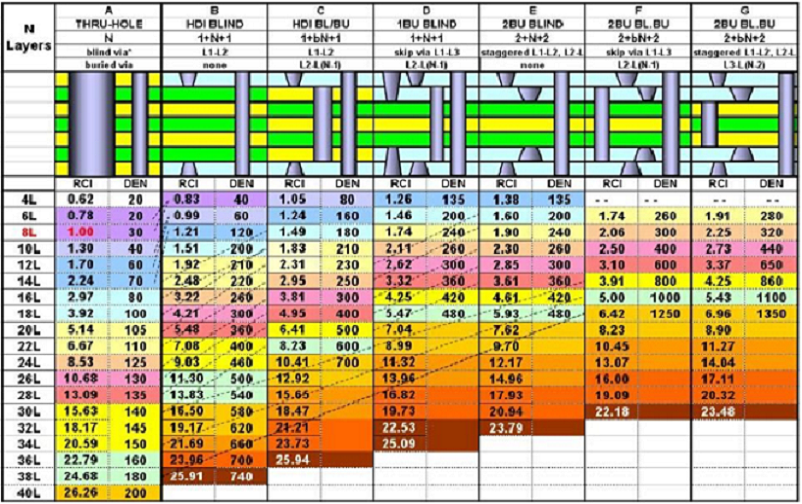
HDI PCB cost and lead time depend on layer count, microvia structure, sequential lamination cycles, material selection, trace and space, via-in-pad, copper thickness, surface finish, impedance control, inspection depth, and whether the order is a standard build, prototype expedite, or emergency turnaround. A simple 1+N+1 hdi pcb prototype can move faster and cost less than a 3+N+3 or any-layer high density interconnect board because each additional build-up cycle adds drilling, plating, lamination, registration control, inspection, and yield risk. For engineers, the most effective way to control hdi pcb fabrication cost is to freeze the stack-up early, standardize materials, reduce unnecessary lamination cycles, and complete DFM before release.
HDI PCB Cost
Main Cost Drivers
HDI PCB cost is not driven by board area alone. In many high density interconnect projects, the expensive part is the process sequence, not the square inches of laminate. A small 10-layer hdi circuit board with stacked microvias and VIPPO can cost more than a larger conventional multilayer PCB because it needs laser drilling, sequential lamination, via filling, X-ray, microsection, and impedance control.
| Cost Driver | Typical Cost Impact | Factory Reason |
|---|---|---|
| Layer count | Medium to very high | More cores, prepregs, imaging, lamination |
| Sequential lamination | High | Each cycle adds drilling, plating, pressing, inspection |
| Laser microvias | Medium to high | Laser drilling and microsection validation |
| Via-in-pad VIPPO | High | Filling, capping, planarization, X-ray |
| Fine trace / space | Medium to high | Tighter imaging, thinner copper, lower etch margin |
| Low-loss material | Medium to high | Material cost and stock availability |
| Controlled impedance | Medium | Stack-up modeling, coupons, TDR testing |
| Quick turn service | High | Priority CAM, material pull, overtime, compressed scheduling |
IPC-2226 establishes requirements and considerations for HDI printed boards and structures, while IPC standards are used industry-wide to clarify quality and reliability expectations.
Relative Cost Breakdown
The exact price depends on size, quantity, material, region, and supplier capacity. For engineering planning, it is more useful to view HDI cost as a weighted process model.
| Cost Element | Typical Share in HDI Build | What Changes the Number |
|---|---|---|
| Base laminate and copper | 15-30% | High-Tg FR-4 vs low-loss laminate |
| Imaging and etching | 10-18% | 75/75 microns vs 50/50 microns |
| Drilling and laser processing | 10-20% | Microvia count and drill classes |
| Lamination cycles | 15-30% | 1+N+1 vs 2+N+2 vs 3+N+3 |
| Via filling and VIPPO | 8-18% | Filled via count and pad flatness target |
| Inspection and testing | 5-15% | X-ray, microsection, impedance, IST |
| Engineering and tooling | 5-12% | CAM time, coupons, first article setup |
The most common cost trap is using advanced structures across the whole board when only one BGA region needs them. Local density should drive the HDI type, not the other way around.
HDI PCB Lead Time
Standard Lead Times
HDI PCB lead time is controlled by process steps. Standard lead time normally increases as lamination cycles, microvia layers, special materials, filled vias, and inspection requirements increase.
| HDI Build Type | Typical Prototype Lead Time | Typical Production Lead Time | Main Schedule Driver |
|---|---|---|---|
| 1+N+1 standard HDI | 7-12 working days | 2-4 weeks | One build-up cycle |
| 2+N+2 HDI | 10-18 working days | 3-5 weeks | Two build-up cycles |
| 3+N+3 HDI | 15-25 working days | 4-7 weeks | Multiple lamination cycles |
| Any-layer HDI | 20-35 working days | 6-9 weeks | Filled microvia reliability |
| HDI with assembly | Add 5-15 working days | Add 1-3 weeks | Components, SMT, X-ray, functional test |
Each lamination and plating cycle can add about 1.5 to 2 days of production time because it adds drilling, cleaning, plating, alignment, and inspection work.
Standard Build Turnaround
A standard build is the safest schedule for most engineering releases. It allows the hdi pcb manufacturer to complete CAM review, material confirmation, stack-up modeling, coupon design, production planning, and inspection without forcing risky shortcuts.
A standard build is best when:
- The design uses 2+N+2 or higher stack-up.
- Low-loss material must be ordered or reserved.
- Impedance tolerance is ±10% or tighter.
- Via-in-pad or filled microvias are used.
- The order needs microsection and X-ray reporting.
- Production transfer matters more than the fastest sample date.
Standard turnaround gives the factory time to detect file conflicts before they become scrap.
Prototype Expedite
Prototype expedite is used when EVT or DVT schedule is more important than cost. It can reduce calendar time, but it does not remove physical process steps.
| Expedite Level | Practical Use | Typical Premium Driver |
|---|---|---|
| Mild expedite | Simple 1+N+1 or low-risk 2+N+2 | Priority CAM and scheduling |
| Strong expedite | Dense BGA hdi pcb prototype | Overtime, priority laser, faster inspection |
| Emergency turnaround | Critical demo or urgent failure recovery | Dedicated line time and material reservation |
Prototype expedite works best when the data package is complete. Missing drill files, stack-up ambiguity, or BOM changes can destroy the advantage of an expedited slot.
Emergency Turnaround
Emergency turnaround should be reserved for controlled designs, not uncertain engineering experiments. A rushed HDI build with unclear via structures, unconfirmed material, or incomplete DFM often becomes slower than a standard build because engineering holds and rework consume the saved time.
Emergency turnaround requires:
- Complete Gerber or ODB++ data
- Excellon mechanical drill file
- Laser drill file
- Final stack-up drawing
- Fixed material callout
- Surface finish requirement
- Impedance table
- Via fill and cap notes
- IPC class
- Approved panelization
- No unresolved BGA fanout conflict
Cost and Lead Time Factors
Layer Count and Stack-Up
Layer count affects cost, but HDI structure affects cost more. A 10-layer 1+8+1 board can be cheaper and faster than an 8-layer any-layer HDI if the any-layer structure requires filled microvias across every layer.
| Stack-Up Choice | Cost Level | Lead Time Level | Best Use |
|---|---|---|---|
| 1+N+1 | Lower | Shorter | Moderate BGA density |
| 2+N+2 | Medium | Medium | Dense 0.5 mm BGA |
| 3+N+3 | High | Long | Advanced processors and compact modules |
| Any-layer HDI | Very high | Longest | Extreme density and shortest interconnects |
| Hybrid HDI | Controlled | Controlled | Local HDI zones with standard routing elsewhere |
The best stack-up is the simplest one that can escape the package, maintain impedance, and pass reliability testing.
Materials and Copper
Material availability strongly affects lead time. Standard high-Tg FR-4 is easier to schedule than special low-loss laminate, very thin dielectric, or mixed-material constructions.
| Material Choice | Cost Impact | Lead Time Impact | Engineering Use |
|---|---|---|---|
| High-Tg FR-4 | Low to medium | Shorter | Industrial and general HDI |
| Low Dk / low Df laminate | Medium to high | Medium to long | High-speed and RF |
| Thin build-up dielectric | Medium | Medium | Microvia control |
| Low-profile copper | Medium | Medium | Lower conductor loss |
| Polyimide flex layers | High | Long | Rigid-flex HDI |
| Special substrate materials | Very high | Long | Ultra HDI and advanced modules |
Copper thickness also changes cost. Fine 50/50 micron routing is easier with 9-18 micron copper than with 35 micron copper. Thick copper helps power delivery, but it makes fine etching harder.
Quality and Inspection
Inspection adds cost, but it reduces hidden failure risk. In HDI PCB work, the inspection plan should match the via structure and application.
| Inspection Item | When It Is Needed | Cost / Time Effect |
|---|---|---|
| AOI | All HDI boards | Standard control |
| 100% E-test | Production and prototype | Standard control |
| X-ray | Filled, stacked, VIPPO, BGA areas | Adds inspection time |
| Microsection | Microvias and buried vias | Adds coupon and lab time |
| Impedance TDR | High-speed circuits | Adds coupon testing |
| IST or thermal cycling | High-reliability products | Adds qualification time |
| Warpage check | Large BGA or thin boards | Adds process validation |
IPC-6012 defines qualification and performance requirements for rigid printed boards, including multilayer boards with blind and buried vias.
Tips to Optimize Cost & Lead Time
Standardize Materials
Standardized material is one of the easiest ways to reduce schedule risk. If the design does not need ultra-low loss, do not force a rare material into an early prototype.
Effective material controls:
- Use high-Tg FR-4 when signal speed allows it.
- Use low-loss laminate only on layers that need it.
- Avoid mixing too many material families.
- Confirm laminate availability before routing.
- Keep dielectric thickness options realistic.
- Use common copper weights where possible.
- Avoid changing material after impedance modeling.
Optimize Layer Count
Layer count optimization should start with BGA fanout and power integrity, not with a target number chosen by cost alone.
Good layer-count practice:
- Use local 50/50 micron routing only where needed.
- Add layers only when they reduce routing risk.
- Keep power and ground planes continuous.
- Avoid any-layer HDI unless package density requires it.
- Replace stacked microvias with staggered microvias when space allows.
- Combine HDI and standard routing zones when possible.
- Confirm 1+N+1 or 2+N+2 before moving to 3+N+3.
Integrate DFM
DFM should happen before final layout release. Late DFM often triggers stack-up changes, via changes, pad changes, and impedance changes, all of which increase cost and lead time.
DFM should confirm:
- Minimum trace and space by copper weight
- Microvia diameter and dielectric depth
- Via-in-pad fill and cap requirement
- Annular ring
- Solder mask clearance
- Controlled impedance coupon
- Material availability
- Lamination sequence
- Panel utilization
- Inspection coupon location
- IPC class
- Surface finish
Two Key Comparisons
Standard Build vs Expedite
| Item | Standard Build | Prototype Expedite |
|---|---|---|
| Cost | Lower | Higher |
| Lead time | Longer but stable | Shorter if files are complete |
| Engineering review | More complete | Compressed |
| Material flexibility | Better | Limited to available stock |
| Best use | Production-ready validation | Urgent EVT or demo build |
| Main risk | Slower schedule | Higher price and less correction time |
Simple HDI vs Complex HDI
| Item | Simple HDI | Complex HDI |
|---|---|---|
| Typical structure | 1+N+1 | 3+N+3 or any-layer |
| Microvia count | Lower | Higher |
| Lamination cycles | Fewer | More |
| Cost | Lower | Much higher |
| Lead time | Shorter | Longer |
| Best use | Moderate BGA escape | Dense processor or AI module |
| Main risk | Routing limitation | Yield and reliability control |
Quality Control Plan
Cost-Safe QC
Cost reduction should not remove the controls that protect HDI reliability. The right approach is to apply inspection where the risk exists.
Minimum HDI QC plan:
- CAM and DFM review
- Material certificate check
- Inner-layer AOI
- Laser drill inspection
- Plating thickness check
- 100% E-test
- Microsection for microvias
- Impedance coupon testing when needed
- Final visual inspection
- Packaging and traceability review
High-Reliability QC
For medical, aerospace, automotive, AI hardware, RF, or industrial control products, add stronger validation.
High-reliability QC may include:
- X-ray for stacked microvias and VIPPO
- Microsection per panel during pilot
- IST or thermal cycling
- Warpage check after reflow simulation
- TDR report for every impedance lot
- Solderability test for aged stock
- Assembly feedback loop from PCA failures to PCB process
PCB is the bare board. PCA is the assembled circuit board with components, solder joints, labels, firmware, inspection records, and functional test data. A bare hdi pcb can pass E-test while the PCA fails because of BGA voiding, warpage, signal margin, or thermal behavior.
Real Factory Case
Project Background
A compact industrial AI camera used a 0.4 mm BGA processor, LPDDR memory, MIPI camera input, USB, PMIC, flash, and two board-to-board connectors. The customer wanted an emergency hdi pcb prototype because the enclosure tooling schedule was fixed.
| Item | Initial Request | Revised Build Plan |
|---|---|---|
| Board type | Any-layer HDI | 2+6+2 HDI |
| Layer count | 10 layers | 10 layers |
| BGA pitch | 0.4 mm | 0.4 mm |
| Trace / space | 50/50 microns full board | 50/50 microns local, 75/75 elsewhere |
| Microvia | Stacked microvias | Staggered where possible |
| Material | Special low-loss full stack | Low-loss only on high-speed layers |
| Finish | ENIG | ENIG |
| Impedance | 90 ohm USB, 100 ohm MIPI | Same |
| Inspection | E-test only requested | E-test, X-ray, microsection, TDR |
Cost and Lead Time Problem
The first request created avoidable cost and schedule risk:
- Any-layer HDI required more filled microvias than the BGA escape actually needed.
- Full-board 50/50 micron routing forced thin copper over areas that did not need fine lines.
- Special low-loss material across all layers added material wait time.
- No microsection coupon was defined near the BGA escape field.
- The customer requested emergency turnaround but had not locked the stack-up.
Factory review found that the same routing goal could be achieved with a 2+6+2 structure, local 50/50 micron routing under the BGA, 75/75 micron routing elsewhere, low-loss material only on high-speed layers, and staggered microvias for non-critical transitions.
Improvement Result
| Metric | Original Plan | Revised Plan |
|---|---|---|
| HDI structure | Any-layer | 2+6+2 |
| Lamination cycles | Higher | Reduced |
| Local fine-line area | Full board | BGA and high-speed zones only |
| Estimated prototype lead time | 24 working days | 16 working days |
| Estimated fabrication cost | Baseline 100% | 72% of baseline |
| First-pass bare-board yield | Not released | 94.8% |
| PCA functional yield after review | Not released | 97.1% |
The cost reduction did not come from lowering quality. It came from removing unnecessary HDI complexity while keeping the features that controlled BGA escape, impedance, and reliability.
Common Design Errors
Cost Errors
- Using any-layer HDI when Type II solves the routing
- Applying 50/50 micron routing across the entire board
- Selecting low-loss material on layers that carry low-speed signals
- Using stacked microvias where staggered vias fit
- Calling VIPPO on non-solderable pads
- Adding controlled impedance to nets that do not need it
- Choosing rare material before checking availability
Lead Time Errors
- Releasing Gerber files before stack-up approval
- Missing laser drill files
- Changing material after quote
- Requesting expedite with unresolved DFM issues
- Missing IPC class and acceptance notes
- Not defining via fill and cap requirements
- Waiting until after fabrication to design impedance coupons
Production Errors
- Reducing inspection to save cost on high-risk structures
- No microsection near critical microvia fields
- No X-ray plan for stacked or filled vias
- No panelization review
- Ignoring copper balance
- Not checking warpage for thin HDI boards
- Treating hdi pcb prototype lead time as equal to production lead time
FAQ About HDI PCB Cost and Lead Time
Question: What affects HDI PCB cost the most?
Answer: HDI PCB cost is most affected by sequential lamination cycles, layer count, microvia diameter, via-in-pad filling, fine trace and space, special materials, controlled impedance, inspection depth, and urgency. Board area matters, but process complexity usually matters more.
Question: How long does an HDI PCB prototype take?
Answer: A simple 1+N+1 hdi pcb prototype may take about 7-12 working days, while 2+N+2 can take 10-18 working days. Complex 3+N+3 or any-layer HDI can take 15-35 working days depending on material, via filling, inspection, and factory loading.
Question: How can engineers reduce HDI PCB lead time?
Answer: Engineers can reduce lead time by standardizing materials, locking the stack-up early, using the simplest HDI type that meets routing needs, avoiding unnecessary stacked vias, completing DFM before release, and providing complete Gerber, drill, laser drill, impedance, material, and inspection data.
Question: Is expedited HDI PCB fabrication always worth it?
Answer: Expedited hdi pcb fabrication is useful for urgent EVT, DVT, or demo builds, but it is only effective when files are complete and the design is inside the manufacturer’s stable process window. Expedite cannot remove physical steps such as lamination, plating, filling, and inspection.

![Understanding PCB Costs & Pricing [Your Complete Guide]](https://hdicircuitboard.com/wp-content/uploads/elementor/thumbs/Understanding-PCB-Costs-Pricing-Your-Complete-Guide-qzzhe6mcaxuolkux3xalfktgavumi9y1aqfbs9bpv4.webp "Understanding PCB Costs & Pricing [Your Complete Guide]")